


How to Properly Install and Replace Bucket Teeth?
Bucket teeth are critical wear-resistant components for excavators, loaders, mining and construction heavy equipment. Proper bucket tooth installation and replacement directly affects equipment working efficiency, construction safety, service life of bucket accessories, and overall operating costs. Unstandardized installation or delayed replacement will cause tooth loosening, abnormal wear, bucket damage, and even construction downtime.
This article systematically sorts out professional knowledge about bucket tooth replacement, standard installation steps, common mistakes and maintenance tips in table format, providing reliable guidance for construction teams and equipment managers.
1. When to Replace Bucket Teeth (Replacement Judgment Standard)
Regular inspection and timely replacement of excavator bucket teeth and loader bucket teeth is the key to maintaining equipment performance.
It is necessary to replace old bucket teeth in the following situations:
1.1. The tooth tip wear exceeds 1/3 of the total tooth length, resulting in reduced digging force and slow construction efficiency;
1.2. Crack, deformation, tooth root breakage or pin hole damage occurs, which cannot be fixed;
1.3. Frequent loosening of bucket teeth due to pin hole abrasion, affecting construction safety;
1.4. Severe corrosion and aging of mining bucket teeth after long-term high-intensity mining operations. Timely replacement of worn bucket teeth can avoid secondary damage to bucket adapters and reduce later maintenance costs.
2. Pre-Work Preparation for Installation & Replacement
Before carrying out step-by-step bucket tooth installation and replacement work, complete standardized preparation to ensure construction safety and installation accuracy:
2.1. Site & equipment preparation: Park the heavy equipment on flat and stable ground, lower the bucket steadily, turn off the equipment power, and lock the operating system to prevent accidental startup;
2.2. Tool preparation: Prepare punch, soft-faced hammer, pin removal tool, wire brush, lubricating grease, new bucket teeth, matching locking pins and retainers;
2.3. Safety preparation: Wear safety gloves, protective goggles, steel-toe safety boots and other PPE to avoid injury caused by iron debris and tool impact;
2.4. Parts inspection: Check whether the new casting bucket teeth and pins are complete, model-matched and free of cracks or defects to ensure adaptability with the bucket adapter.
3. Standard Steps for Removing Old Bucket Teeth
Scientific disassembly is the premise of successful replacement, avoiding damage to the bucket adapter:
3.1. Clean the dirt, sediment and rust on the bucket tooth surface, adapter and pin holes with a wire brush to expose the complete locking structure;
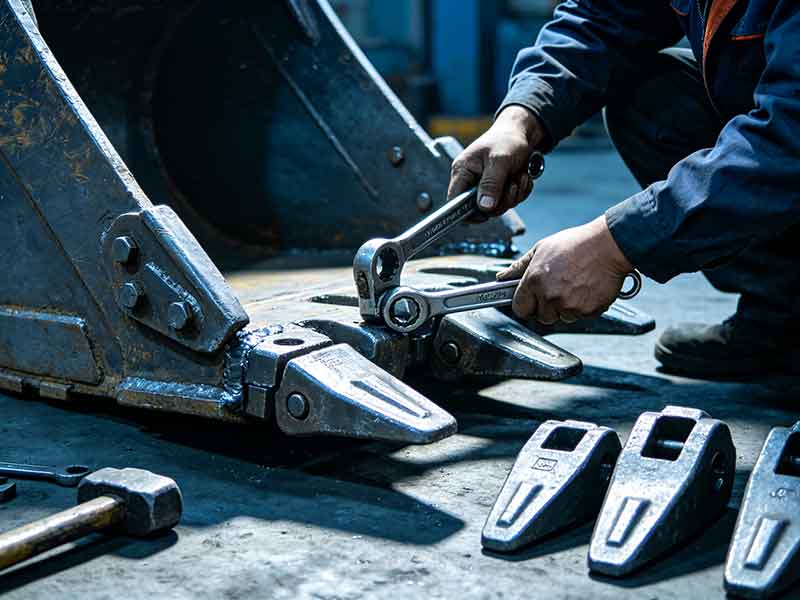
3.2. Fix the bucket tooth steadily, use a punch and soft hammer to slowly knock out the locking pin or spring retainer along the pin hole direction;
3.3. For severely corroded and stuck old bucket teeth, slightly pry the tooth body to loosen the fit gap, and then slide the old tooth out along the adapter track;
3.4. After disassembly, thoroughly clean the adapter surface and pin holes again to remove residual rust and sundries, ensuring a flat and smooth installation base for new parts.
4. Standard Bucket Tooth Installation Steps
Follow professional procedures to install cost-effective bucket tooth replacement solution parts to ensure firm fit and long service life:
4.1. Lubricate the adapter contact surface and the inner cavity of the new bucket tooth with a thin layer of grease to reduce installation friction and prevent rust and jamming in later use;
4.2. Align the inner chute of the new bucket tooth with the bucket adapter, push the tooth body forward steadily until it is completely attached in place without gap or skew;
4.3. Accurately align the pin holes of the bucket tooth and the adapter, insert the new special locking pin, and use a hammer to knock the pin until it is completely flush and locked;
4.4. Install the supporting retainer or cotter pin to strengthen the fixing effect and prevent the pin from falling off during high-frequency vibration operation;
4.5. Manual inspection: Shake the bucket tooth slightly to confirm no looseness, deflection or displacement, ensuring the installation meets construction standards.
5. Common Installation Mistakes & Avoidance Tips
Many equipment failures are caused by non-standard installation of heavy equipment bucket tooth replacement:
5.1. Avoid using damaged or mismatched pins and retainers, which will lead to tooth loosening and falling off during operation;
5.2. Do not skip the cleaning and lubrication process, residual sundries will cause uneven stress and accelerated wear of bucket teeth;
5.3. Avoid skewed installation of bucket teeth, asymmetric force will lead to premature cracking and scrapping of single tooth;
5.4. Do not use hard steel hammers to knock the tooth body violently, which will cause hidden cracks in casting bucket teeth and affect service life;
5.5. Avoid incomplete pin penetration, insufficient locking will cause safety hazards in high-load digging and mining operations.
6. Post-Installation Inspection & Daily Maintenance
After completing bucket tooth installation, standardized inspection and daily maintenance can extend the service life of wear parts:
6.1. Empty load test: Operate the equipment for 5-10 minutes of empty load digging to check whether the bucket teeth are loose or abnormal;
6.2. Regular inspection: Check the tightness of bucket teeth and pins every week during construction periods, and replace loose and aging accessories in time;
6.3. Anti-rust maintenance: Clean sediment and moisture after daily operation, and apply anti-rust grease to the pin holes and fitting parts for long-term idle equipment;
6.4. Uniform wear control: Adjust the operation mode to avoid long-term single-side force on bucket teeth, ensuring synchronous wear of all teeth and reducing overall replacement frequency.
Types of Excavator Bucket Teeth
Below is a structured English table classifying bucket teeth by 4 core industry-standard dimensions, with detailed descriptions, key features and typical applications:
1. Bucket Teeth Classified by Function & Application
| Bucket Tooth Type | Core Description | Key Features | Typical Applications |
|---|---|---|---|
| Standard Chisel Teeth | All-round general-purpose teeth | Balanced penetration, wear & impact resistance, cost-effective | General earthmoving, soft-medium soil, sand, gravel |
| Tiger Teeth | Penetration-optimized sharp teeth | Narrow pointed tip, high tensile strength, deep penetration | Hard compacted soil, rocky terrain, shale, icy ground |
| Rock Teeth | Heavy-duty hard rock teeth | Thickened body, reinforced tip, high hardness, extreme impact resistance | Mining, quarrying, hard rock/ore, granite, basalt |
| Flat Teeth | Wide flat-tipped scooping teeth | Large contact area, high loading efficiency, low material adhesion | Sand/gravel handling, backfilling, debris removal, asphalt demolition |
| Wear-Resistant Teeth | Surface-treated high-wear teeth | Surface hardened (HRC55-60), extended service life, high abrasion resistance | Gravel plants, mining, aggregate processing, fine ore handling |
| Tapered Teeth | Coal mining specialized teeth | Tapered structure, easy coal seam insertion, high lump coal recovery | Underground/open-pit coal mining, coal seam excavation |
| Asphalt/Concrete Cutting Teeth | Pavement breaking specialized teeth | Sharp reinforced edge, high bending strength, impact-resistant | Road demolition, pavement repair, concrete/asphalt layer removal |
2. Bucket Teeth Classified by Installation Method
| Bucket Tooth Type | Core Description | Key Features | Typical Applications |
|---|---|---|---|
| Pin-On Teeth | Pin-retained standard teeth | Quick install/replace, reliable locking, wide compatibility | General construction, earthmoving, frequent tooth replacement scenarios |
| Bolt-On Teeth | High-strength bolt-fixed teeth | Ultra-stable connection, high load-bearing, anti-loosening | Heavy-duty mining, large quarrying, ultra-heavy excavators |
| Weld-On Teeth | Directly welded permanent teeth | Maximum durability, no falling-off risk, high structural strength | Long-term fixed projects, heavy mining, infrequent tooth replacement |
3. Bucket Teeth Classified by Structural Design
| Bucket Tooth Type | Core Description | Key Features | Typical Applications |
|---|---|---|---|
| Integral (One-Piece) Teeth | Single forged/cast unit | Simple structure, low cost, easy full replacement | Small excavators, general earthworks, low-medium strength tasks |
| Split (Two-Piece) Teeth | Modular tip + separate adapter | Only replace worn tip, low cost, easy maintenance, high wear resistance | Large excavators, mining, large water conservancy projects, high-intensity operations |
4. Bucket Teeth Classified by Manufacturing Material
| Bucket Tooth Type | Core Description | Key Features | Typical Applications |
|---|---|---|---|
| High Manganese Steel Teeth | Impact-resistant work-hardening steel | Exceptional toughness, surface hardens under impact, fracture-resistant | Mining, quarrying, rock excavation, high impact load scenarios |
| Alloy Steel Teeth | Heat-treated balanced performance steel | Uniform hardness, good comprehensive mechanical properties, stable performance | General construction, earthmoving, medium-duty excavation, standard working conditions |
| Carbide-Tipped Teeth | Tungsten carbide insert reinforced teeth | Ultra-high hardness (up to HRC70), extreme wear resistance, long service life | High-abrasion environments, aggregate processing, high-abrasive ore mining |
| Cast Iron Teeth | Low-cost basic cast teeth | Low manufacturing cost, easy casting, moderate hardness | Light-duty landscaping, small-scale earthmoving, low-intensity non-abrasive tasks |
Truecasteng Company Introduction – Professional Casting Bucket Tooth Manufacturer from China
Turecast is a professional Chinese casting factory with more than 30 years of mature casting production experience, focusing on the R&D, production and customization of high-quality heavy machinery wear parts, mainly including excavator bucket teeth, loader bucket teeth, mining bucket teeth and supporting bucket adapters, pins and retainers.
We have rich experience in serving American market customers, providing diversified, customized and cost-effective bucket tooth solutions for various construction, mining and engineering machinery equipment. Through optimized casting formulas, streamlined production processes and refined cost control, we successfully help global customers reduce comprehensive equipment wear parts costs by 10% while ensuring the high hardness, wear resistance and impact resistance of bucket teeth products.
Adhering to strict casting process standards and quality inspection systems, our factory has stable production capacity and reliable product quality, and has established long-term stable cooperative relationships with global customers.