


2026 Industry Trend: High-Toughness Lightweight Leaf Spring for Semi Trailers
Introduction
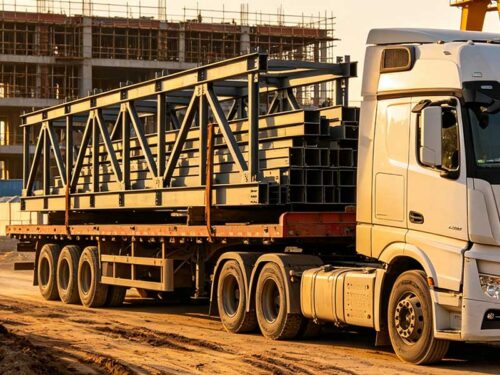
Global road freight volume surges in 2026, pushed by cross-border logistics, e-commerce last-mile heavy transport, and stricter carbon emission regulations across North America, EU, and Asia-Pacific. For semi-trailer manufacturers and fleet owners, unsprung mass reduction has become a non-negotiable optimization target: every kilogram cut from suspension directly boosts payload, slashes fuel consumption, and lowers carbon footprints.
High-toughness lightweight leaf springs have emerged as the core suspension upgrade for modern semi-trailers in 2026. Unlike traditional multi-leaf steel springs that add excess dead weight, the new generation balances ultra-light weight, extreme load resistance, anti-fatigue performance, and long service life.
1. 2026 Global Sales & Market Scale of Lightweight Semi-Trailer Leaf Springs
Core Market Data Overview
As per Marketresearchfuture Insights, The global commercial vehicle leaf spring market reaches USD 5.32 billion in 2026, with semi-trailer leaf springs accounting for 42% of total shipment volume, driven by parabolic high-strength steel and composite lightweight variants.
- Conventional multi-leaf steel springs: 68% market share (declining 7.1% YoY)
- High-toughness parabolic lightweight steel leaf springs: 24% market share (22.6% YoY growth)
- GFRP/CFRP composite lightweight leaf springs: 8% market share (52.3% YoY explosive growth)
Total 2026 global lightweight leaf spring shipments for semi-trailers hit 18.7 million units, segmented by region:
- Asia-Pacific: 46% (8.6 million units, led by China, Southeast Asia logistics fleets)
- North America: 24% (4.5 million units, DOT-compliant parabolic steel mainstream)
- Europe: 19% (3.6 million units, composite springs widely adopted for low-carbon fleets)
- Rest of World: 11% (2.0 million units, cost-effective high-strength steel dominant)
Table 1: 2026 Sales Volume & Weight-Saving Performance by Lightweight Leaf Spring Type
| Leaf Spring Type | 2026 Global Shipment (Million Units) | Average Weight Reduction vs Traditional Multi-Leaf Steel | Key Target Semi-Trailer Scenarios |
|---|---|---|---|
| High-Toughness Parabolic HSLA Steel | 14.2 | 20–30% | General cargo, bulk transport, aftermarket replacement |
| GFRP Glass Fiber Composite | 3.8 | 50–60% | Electric semi-trailers, long-haul logistics fleets |
| CFRP Carbon Fiber Composite | 0.7 | 70–80% | Premium OEM low-carbon trailers, high-value cargo transport |
Data Source: Verified Market Reports 2026 Heavy-Duty Suspension Component Report
2. Material Performance Analysis: Core Lightweight Spring Materials for Semi-Trailers
Three mainstream material solutions dominate the 2026 lightweight leaf spring market, each balancing toughness, weight, cost, and fatigue resistance for different semi-trailer load requirements.
Table 2: Material Property Comparison for Semi-Trailer Lightweight Leaf Springs
| Material Grade | Tensile Strength (MPa) | Fatigue Cycle Lifespan | Corrosion Resistance | Unit Cost Index (Traditional Steel = 1.0) | Core Pros & Cons |
|---|---|---|---|---|---|
| HSLA Parabolic Steel (50CrV4 / 60Si2Mn) | 1500–1800 | 250,000+ cycles | Moderate (anti-rust coating required) | 1.1 | Pros: Mature manufacturing, high impact toughness, compatible with all heavy-load trailers
Cons: Limited weight reduction, higher maintenance |
| E-Glass Epoxy GFRP Composite | 1200–1400 | 500,000+ cycles | Excellent (no rust) | 1.6 | Pros: 50% weight cut, superior vibration damping, long service intervals
Cons: Slightly lower impact resistance for extreme off-road transport |
| Carbon Fiber Epoxy CFRP Composite | 2000–2400 | 600,000+ cycles | Perfect | 3.2 | Pros: Max weight saving, ultra-high toughness, low carbon footprint
Cons: High raw material cost, limited mass production capacity |
Key 2026 material trend: Mixed composite-steel hybrid springs gain traction. OEMs pair HSLA steel main leaves with thin GFRP auxiliary leaves to cut 25% weight while controlling production costs, ideal for mid-range standard semi-trailers.
3. Advanced Manufacturing Processes for High-Toughness Lightweight Leaf Springs
Production technology directly determines spring toughness, weight consistency, and fatigue lifespan. 2026’s top-tier suppliers adopt two distinct process lines for steel and composite lightweight springs:
3.1 High-Strength Parabolic Steel Leaf Spring Workflow
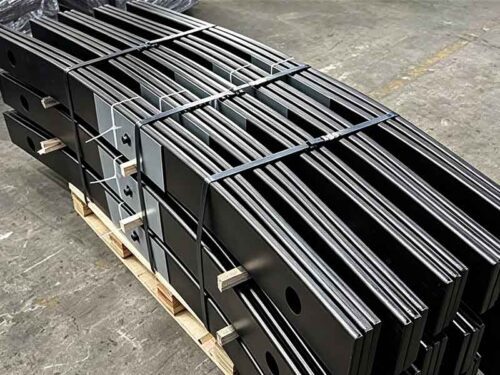
- Precision blanking & tapering: CNC cutting for variable-thickness parabolic profiles to evenly distribute load stress
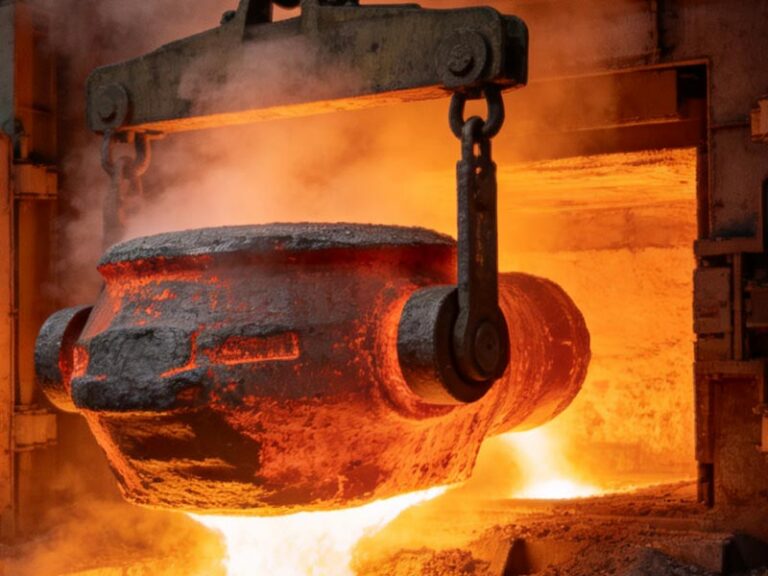
- Hot forming & controlled gradient quenching: Precise temperature control to lock high tensile strength without brittleness
- Low-temperature tempering: Balances hardness (45–50 HRC) and fracture toughness to resist heavy semi-trailer shock loads
- Automated shot peening: Induces surface compressive stress, boosting fatigue life by 40%
- Electrophoretic anti-corrosion coating: Resists road salt and rain for long-haul cross-region transport
- Load presetting & 100% fatigue testing: Each spring undergoes full-load cycle inspection before delivery
3.2 GFRP/CFRP Composite Leaf Spring Production Process
- Continuous fiber layup: Align glass/carbon fibers along the main stress axis to maximize load-bearing efficiency
- Vacuum resin infusion: Eliminate internal air bubbles to avoid crack propagation under heavy vibration
- Molded high-temperature curing: One-piece mono-leaf shaping without multi-layer assembly gaps
- CNC edge finishing & protective surface film
- Static load, impact and cyclic fatigue bench testing to meet EU CE / US DOT standards
Critical 2026 manufacturing upgrade:
Intelligent robotic production lines. Leading suppliers deploy automated fiber layup and heat treatment monitoring to reduce dimensional tolerance error below ±0.5mm, ensuring uniform toughness across bulk orders.
4. 2026–2031 Future Industry Trends for Lightweight Semi-Trailer Leaf Springs
Trend 1: Policy-Driven Lightweight Mandates Accelerate Composite Penetration
EU CBAM carbon border tax, US EPA freight efficiency rules, and Asia’s commercial vehicle lightweight standards force OEMs to cut trailer curb weight by minimum 10%. Composite leaf spring penetration will rise from 8% (2026) to 22% by 2031, while parabolic HSLA steel remains the volume mainstream for cost-sensitive fleets.
Trend 2: Integrated Smart Sensing Leaf Springs Become Standard Premium Specs
Top manufacturers embed miniature fiber-optic sensors inside composite springs to monitor real-time load, stress, and fatigue damage. This IoT-enabled design helps fleet operators predict suspension failure, cut downtime, and optimize semi-trailer payload distribution — a key differentiator for electric semi-trailer platforms in 2027+.
Trend 3: Low-Carbon Green Manufacturing Becomes Supplier Entry Threshold
Buyers now prioritize suppliers with EPD (Environmental Product Declaration) reports for component carbon footprints. Traditional steel spring factories without energy-saving heat treatment lines will lose large OEM tender opportunities after 2027.
Trend 4: Mono-Leaf Design Fully Replaces Multi-Leaf Structures
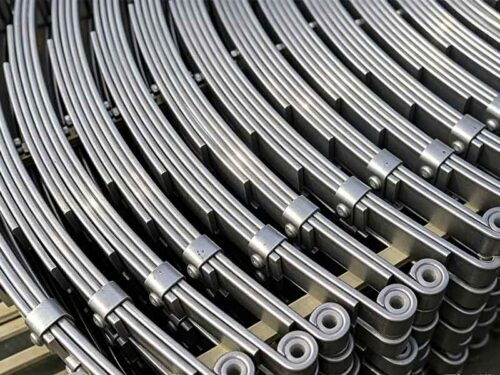
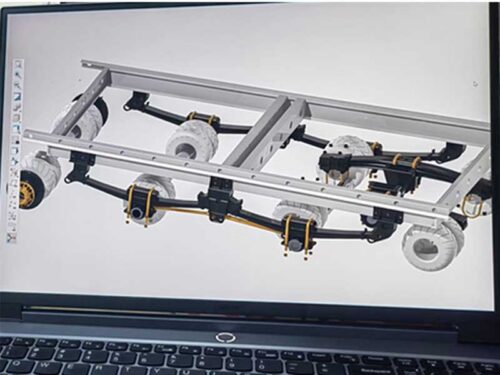
Multi-leaf steel springs will account for less than 40% of semi-trailer suspension demand by 2030. Mono parabolic steel and mono composite springs eliminate friction between stacked leaves, reduce wear noise, and deliver consistent elastic performance under variable heavy loads.
5. Complete Procurement Guide for High-Toughness Lightweight Leaf Springs (Semi-Trailer Buyers)
Whether you are an OEM mass purchaser, fleet aftermarket manager, or suspension distributor, follow these 6 core procurement rules to avoid low-toughness, substandard lightweight springs:
Rule 1: Verify Supplier Qualifications First
Mandatory certifications: IATF 16949 automotive quality, ISO 9001, regional compliance (DOT for North America, CE for EU)
Prioritize factories with ≥5 years of semi-trailer lightweight spring dedicated production; avoid general machinery spring manufacturers
Request official Material Test Reports (MTR) for all steel/composite raw material batches
Rule 2: Match Material Type to Your Trailer Application
Short-haul bulk cargo / budget fleets: Select parabolic HSLA steel (best cost-performance balance)
Long-haul logistics / electric semi-trailers: Choose GFRP composite to maximize payload and cut fuel/electricity costs
Premium low-carbon OEM trailers: Adopt CFRP composite for maximum weight reduction and extended service cycles
Rule 3: Inspect Core Toughness & Production Process Credentials
For steel springs: Confirm shot peening and gradient heat treatment processes; test hardness range 45–50 HRC
For composite springs: Request third-party fatigue test reports (minimum 500,000 load cycles without cracking)
Reject suppliers that skip full-load presetting testing before shipment
Rule 4: Control Cost Without Sacrificing Durability
Avoid ultra-low-cost generic springs using recycled scrap steel or low-grade short-cut fiber composites — these lose toughness rapidly under heavy semi-trailer loads and trigger frequent replacement costs.
Opt for hybrid steel-GFRP springs as a mid-tier cost-saving solution if full composite budgets are limited.
Rule 5: Evaluate Production Capacity & Delivery Stability
Check monthly output ≥10,000 units for bulk OEM orders; confirm on-time delivery rate ≥95% to avoid trailer assembly line delays
Validate export logistics experience for cross-border orders (customs documentation, sea freight packaging anti-collision protection)
Rule 6: Sample Testing Before Bulk Order Placement
Order pre-production samples to conduct real-world load testing matching your semi-trailer’s maximum rated payload; inspect surface finish, arch height consistency, and anti-corrosion coating adhesion before signing large purchase contracts.
6. Conclusion
2026 marks a decisive turning point for semi-trailer suspension lightweighting: high-toughness parabolic steel and composite leaf springs are no longer optional upgrades but standard requirements for OEMs and fleets chasing efficiency, carbon compliance, and long-term total cost savings.
While HSLA parabolic steel retains dominant market share for cost-sensitive mass applications, GFRP and CFRP composite springs will capture fast-growing demand from electric semi-trailers and global low-carbon logistics fleets over the next five years.
For buyers, successful lightweight spring procurement hinges on aligning material selection with trailer usage scenarios, auditing supplier manufacturing processes and toughness testing standards, and balancing upfront component cost against long-term payload and maintenance savings. As material science and intelligent production advance, lightweight leaf springs will redefine the performance benchmark of the global semi-trailer industry through 2031 and beyond.