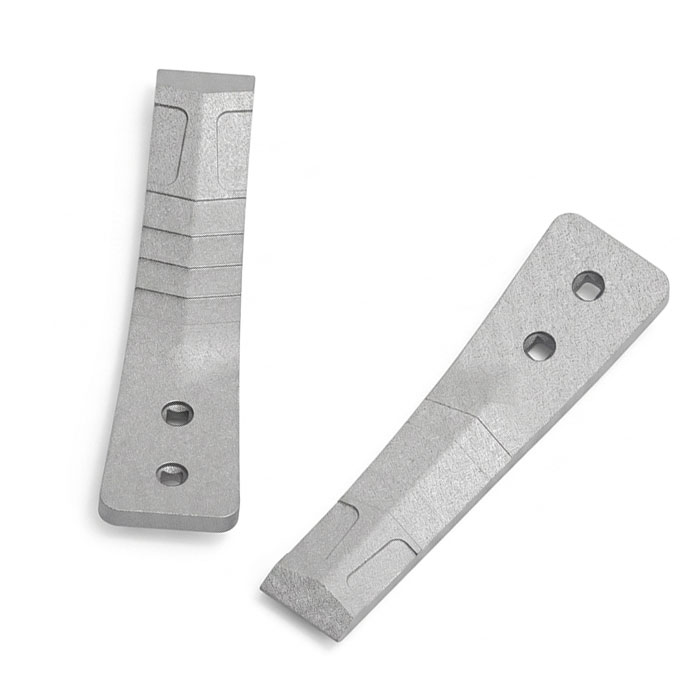



Moldboard Plow, Chisel Plow and Subsoiler: Tillage Machine Comparison & Wear Parts Sourcing Guide
Primary tillage forms the foundation of farmland preparation, with three dominant heavy-duty implements leading the market: Moldboard Plow, Chisel Plow, and Subsoiler (also known as Ripper). Distinguishing their working mechanisms, dimensional specifications, manufacturing processes, and field applications enables agricultural equipment dealers and farmers to make targeted purchases of wear-resistant tillage components.
This article covers their operational differences, technical specifications, production craftsmanship, practical usage scenarios, and customized procurement recommendations for core wear parts.
1. 2026 Global Primary Tillage Equipment Sales Overview & Segmented Performance
Global demand for conservation tillage machinery continues to surge in 2026, driven by policy incentives for soil health restoration and reduced irrigation consumption across North America, Europe, and Australia.
Segmented sales data reflects clear market demand stratification for the three core tillage machines:
Chisel Plow: Top-selling mass-volume product, accounting for nearly 52% of primary tillage unit shipments. As a core tool for no-till and residue retention farming, its low tractor horsepower requirement and frequent replacement of sweeps/spikes create steady repeat order streams for wear part suppliers.
Moldboard Plow: Steady mid-tier market share at 31%. Conventional full inversion tillage remains essential for weed eradication and fallow land renovation, with demand concentrated in grain and vegetable planting zones. Its wear parts (plow points, moldboards, shins) serve as standard inventory items for agricultural retailers.
Subsoiler/Ripper: High-margin niche segment holding 17% of total sales. Though unit sales volume is the lowest, each machine requires premium heavy-duty wear components. Operators target compacted hardpan soil, and premium reinforced ripper points command higher profit margins for casting and forging manufacturers.
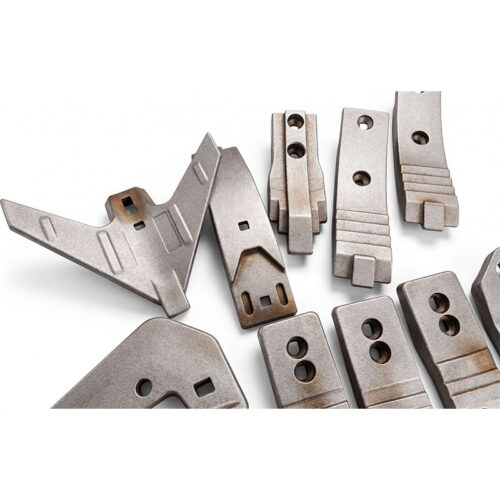
2. Technical, Dimensional & Application Comparison of Three Tillage Implements
The following table systematically contrasts working depth, tine density, traction requirements, core functions and field characteristics:
Key Functional & Structural Comparison of Moldboard Plow, Chisel Plow and Subsoiler
| Comparison Dimension | Moldboard Plow | Chisel Plow | Subsoiler / Ripper |
|---|---|---|---|
| Operating Depth | Shallow to medium layer: 15–30cm | Medium layer: 20–40cm | Ultra-deep layer: 40–75cm+ |
| Tine/Share Density | Independent single moldboard units, spaced widely | Dense tines, ~30cm spacing; dozens of spikes per unit | Sparse heavy-duty tines, 60–90cm spacing; only 3–6 thick ripper shanks per machine |
| Tractor Traction Demand | Moderate; medium-large tractors compatible with wide units | Moderate traction load | Extremely high power demand: 30–50 HP required per single ripper tine |
| Core Tillage Purpose | Fully invert topsoil 135°–180°, bury weeds and crop residue completely | Loosen planting layers, cut surface weed roots, retain 50%–70% surface residue for conservation tillage | Shatter compacted hardpan subsoil, restore underground drainage & aeration, boost crop root penetration |
| Surface Post-Tillage Appearance | Bare fresh overturned topsoil, no residue left on field surface | Rough ground with heavy stubble coverage | Minimal surface disturbance; deep underground fissures invisible from above ground |
Dimensional & Craftsmanship Differentiation
-
Moldboard Plow
Size Specifications: Single moldboard width ranges 30–50cm; multi-bottom plows commonly feature 3–8 working units. Parts feature large curved, wide-area surfaces for soil sliding.
Manufacturing Process: Core wear parts (plow point, moldboard, shin) rely on high-carbon steel stamping or precision investment casting, paired with surface quenching. Finished components require ultra-smooth surface finishes to cut down soil sliding resistance and abrasive wear.
Core Wear Mechanism: Continuous large-area sliding abrasive wear against topsoil. -
Chisel Plow
Size Specifications: Narrow spike-style working ends; dense tine layout with 25–35cm row spacing. Replaceable wide chisel sweeps range 10–25cm in width.
Manufacturing Process: Medium carbon steel or boron steel forging is the standard process. Balanced hardness and toughness are prioritized to withstand frequent medium soil impact and mixed abrasive friction.
Core Wear Mechanism: Moderate mechanical impact plus mixed abrasive friction from sand-laden mid-layer soil. -
Subsoiler / Ripper
Size Specifications: Extra-thick, reinforced solid shanks with heavy-duty ripper points; ultra-wide spacing between individual tines to disperse extreme underground impact loads.
Manufacturing Process: Full boron steel forging is mandatory. Critical working tips undergo tungsten carbide overlay hardfacing or embedded alloy block inserts to resist rock collision damage.
Core Wear Mechanism: Extreme high-force impact + high-pressure abrasive friction against hardpan and buried rock fragments.
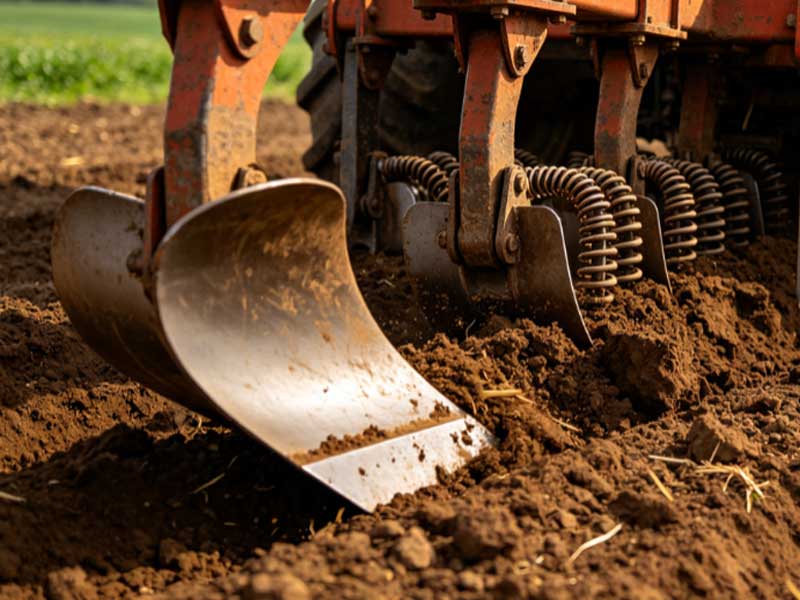
3. Targeted Procurement & Marketing Guidance for Core Wear Parts
Core wear parts are high-consumption agricultural components with distinct wear modes and manufacturing requirements for each machine category. The matrix below outlines core replaceable parts, load characteristics, and supplier production recommendations:
| Machine Type | Core Replaceable Wear Parts | Load & Wear Characteristics | Supplier Production & Sales Recommendations |
|---|---|---|---|
| Moldboard Plow | Plow Point, Moldboard, Shin | Large-area continuous sliding abrasive wear | Prioritize surface hardness and smooth finish. Deploy high-carbon steel stamping or precision casting + surface quenching. As standard universal inventory for farm equipment retailers. |
| Chisel Plow | Chisel Spikes, Wide Chisel Sweeps | Medium impact + mixed sand abrasion; ultra-high replacement frequency | High-volume mass production with strict hole-position precision control. Factory mass production capacity, precision casting/forging hole tolerance accuracy, and cost-effective bulk wholesale pricing. |
| Subsoiler / Ripper | Ripper Points, Subsoiler Shins | Extreme rock impact + high-pressure deep soil friction | Boron steel forging + tungsten carbide hardfacing technology. Extended service life and reduced equipment downtime compared to standard cast steel alternatives prone to fracture when breaking hardpan, cutting costly tractor downtime during critical planting seasons. |
4. Soil Tillage Implements Market Forecast and Outlook 2026 to 2036
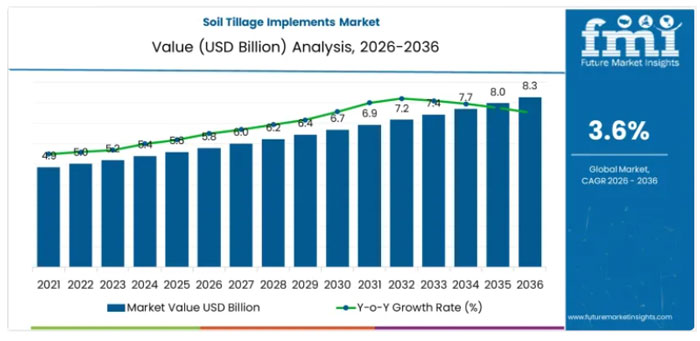
The soil tillage implements market is projected to expand from USD 5.8 billion in 2026 to USD 8.3 billion by 2036, growing at a CAGR of 3.60%. Capital deployment in this market is measured and selective, reflecting its mature structure and replacement-driven demand profile.(Data source: futuremarketinsights)
Investment decisions by manufacturers prioritize incremental capacity expansion, cost-efficient manufacturing, and product upgrades rather than aggressive greenfield builds. Returns are typically realized over medium time horizons through stable dealer networks, aftermarket parts, and recurring replacement cycles tied to farm utilization intensity.
OEMs allocate capital toward strengthening distribution reach, improving durability of wear components, and aligning implements with higher-horsepower tractors and precision farming practices.
Emerging markets attract investment focused on volume scalability and localized production, while developed regions see capital directed toward technology refinement and soil-conservation-compatible designs.
Between 2026 and 2036, expansion is shaped less by rapid demand spikes and more by disciplined capital allocation, predictable cash flows, and sustained replacement demand, supporting steady but controlled investor returns.
5. Trusted Precision Casting Manufacturer: Truecasteng
For global buyers seeking reliable, custom-manufactured agricultural wear parts, Truecasteng delivers consistent high-performance cast and forged components for tillage machinery. For many years, Truecasteng has established itself as a trusted precision casting manufacturer, catering to a global clientele across various sectors, including farming parts, truck parts, and industrial machinery.
Specializing in customized boron steel forgings, tungsten carbide hardfacing solutions, and precision investment casting for moldboard, chisel, and subsoiler wear components, Truecasteng balances mass production efficiency for high-volume chisel plow parts and premium reinforced manufacturing for heavy-duty subsoiler ripper tips. The brand’s integrated foundry and forging workshop enables full technical customization to match regional soil conditions—from sandy topsoil requiring low-friction moldboard components to rock-heavy compacted farmland needing impact-resistant subsoiler wear parts—supporting agricultural equipment distributors worldwide with durable, cost-effective primary tillage wear solutions.