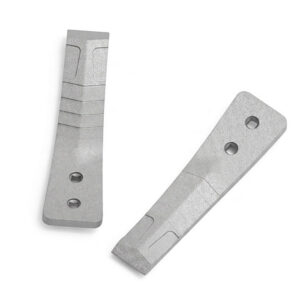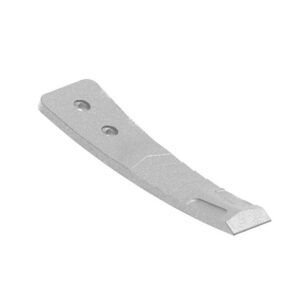



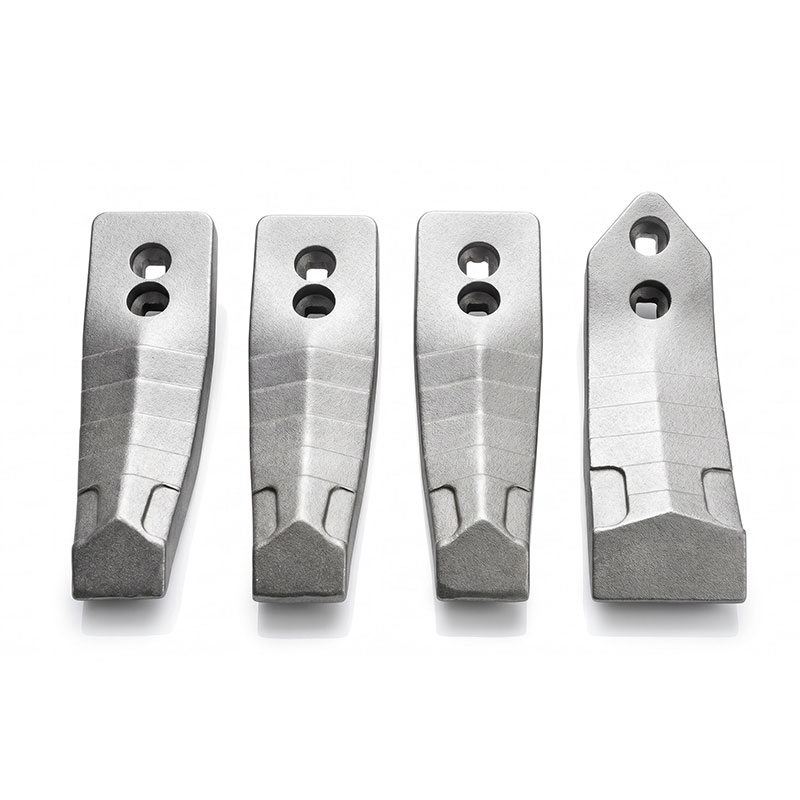
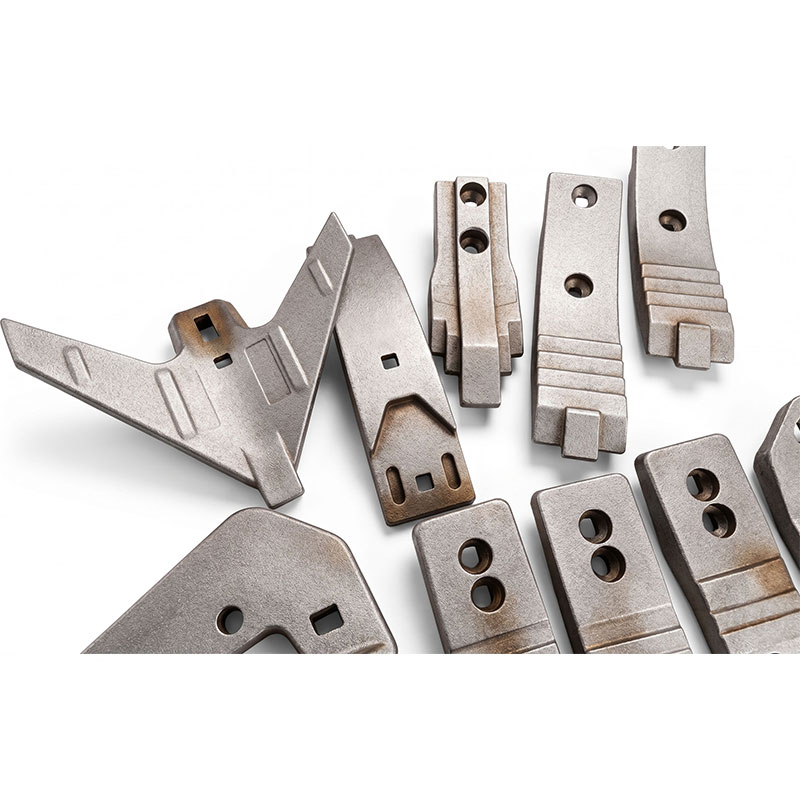
As a core wear-resistant component for deep tillage and breaking up hardpan soil, the dimensions, material, and manufacturing process of a Chisel Plow Point directly determine a tractor’s operational efficiency and the tool’s overall service life.
1. Key Dimensions and Application Scenarios
The specifications of a chisel plow point are determined by its width, thickness, length, and bolt hole spacing. Different shapes and widths alter how the soil is cut, fractured, and turned.
| Type | Common Dimensions | Applications |
| Spike / Straight Points (Narrow Type) | Width is typically 2 inches (approx. 50mm) or narrower; thickness ranges from 1/2″ to 3/4″. | Primarily used for deep ripping/tillage and fracturing hardpan (plow-sole). Its narrow profile minimizes draft resistance, allowing deep soil penetration (up to 20-30 cm) to improve drainage and aeration. It causes minimal soil inversion, maximizing crop residue on the surface (high residue retention) to prevent water and wind erosion. |
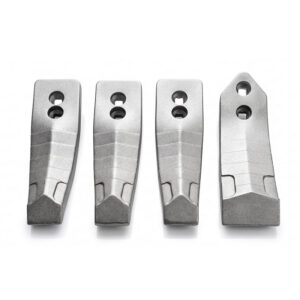
| Reversible Points (Standard Type) | Width of 2–3 inches (approx. 50–75mm); thickness of 1/2″, 5/8″, or 3/4″; length usually ranges from 12 to 16 inches. | The most popular, versatile point style in North American and European markets. Featuring a symmetrical dual-tip design, the operator can flip the point end-for-end once one side wears out, effectively doubling the wear life. It loosens soil while providing moderate soil disturbance and fertilizer mixing. |
| Twisted / Winged Points | Width typically 3–4 inches (approx. 75–100mm) or wider, categorized into Left-hand (LH) and Right-hand (RH) configurations. | Used for secondary tillage, weed eradication, and scenarios requiring aggressive soil turning. The twisted or winged geometry lifts and throws the soil as it moves forward—simulating a moldboard plow effect. This delivers excellent crop residue incorporation and weed burial. |
2. Core Material Specifications
Because chisel plow points encounter severe abrasive wear from sand/soil and high-impact shocks from buried rocks, the material must achieve an optimal balance between hardness (wear resistance) and toughness (impact resistance). Truecasteng can customize chisel plow points in various materials and sizes to meet customer requirements.
| Core Material | Characteristics | Advantages |
| Boron Steel (e.g., 30MnB5) | The gold standard steel for agricultural wear parts, widely adopted by European and global OEMs. After quenching and tempering, it reaches a hardness of HRC 48-52. | Exceptional balanced mechanical properties. High toughness ensures it won’t snap when striking heavy rocks in hard soil, while maintaining excellent wear life. |
| High-Carbon Manganese Steel (e.g., 65Mn / Spring Steel) | A cost-effective material widely used in standard agricultural applications. | Offers great elasticity and decent hardness at an economical price point. However, its wear life falls short compared to boron steel in high-abrasion, dry, or heavy clay environments. |
| Tungsten Carbide Embedded / Hardfaced | High-grade tungsten carbide tiles or inserts are brazed or welded onto the leading edge and high-wear zones of the point. | Hardness exceeds HRC 70+. The wear life can be 3 to 5 times longer than standard steel points. It maintains its sharp, original cutting profile throughout its lifespan, significantly reducing fuel consumption and downtime for mega-farms or abrasive sandy/gravel soils. |
3. Chisel Plow Points Manufacturing Processes
High-performance chisel plow points depend heavily on advanced manufacturing processes to optimize the internal metallurgical grain structure.
3.1. Hot Forging Process
Most straight and reversible bar points are manufactured using hot forging. Steel blanks are heated and formed under high-tonnage forging presses. This creates continuous grain flow lines within the steel, yielding superior impact toughness and preventing structural snapping.
3.2. Casting Process
Complex geometries like heavy-duty winged points or integrated chisel sweeps are often produced via casting, utilizing Ductile Iron (Nodular Iron) or Chromium-Moly Alloy Steel. Casting allows for highly optimized hydrodynamic designs that significantly reduce soil draft resistance.
3.3. Heat Treatment (Through-Hardened vs. Induction)
This is the ultimate differentiator of product quality.
- Through-Hardening: Uniformly hardens the point from the core to the surface, ensuring consistent wear properties as the metal erodes.
- Induction Hardening: Locally hardens the high-wear tips to extreme hardness while leaving the mounting body ductile to absorb shocks.
3.4. Surface Protection
- Hardfacing: Automated welding overlay robots apply hard-surface weld beads along the point edges for added erosion protection.
- Powder Coating / Eco-friendly Painting: Prevents rust during storage and reduces soil stickiness during initial field entry.
4. Procurement Guide
| Sourcing Pillar | Critical Evaluation & Pitfall Prevention |
| 1. Fitment & Compatibility | North American and European agricultural machinery standards vary. You must meticulously verify the Bolt Spacing (typically 1.75″, 2″, or 2.25″) and Bolt Hole Diameter (e.g., 1/2″ or 5/8″ plow bolts). Ensure seamless fitment on major OEM shank brands like John Deere, Case IH, Krause, Great Plains, etc. |
| 2. Soil-to-Material Matching | • Rocky, High-Impact Soil: Prioritize through-hardened Boron Steel. Avoid low-grade cast irons which are brittle and prone to shattering. • Sand / Abrasive, Stone-Free Soil: Highly recommend Tungsten Carbide tipped points. While the initial unit price is higher, international commercial buyers focus heavily on the “cost-per-acre,” making extended-life products highly lucrative for B2B portfolios. |
| 3. Quality Control (QC) Inspection | For batch orders, test the flatness of the mounting surface (uneven surfaces loosen bolts during operation), check the uniformity of the countersunk holes, and perform random Rockwell Hardness (HRC) tests. |
| 4. Packaging & Rust Prevention | Ag-parts are heavy, sharp, and shipped in bulk pallets or crates. Ensure products undergo high-quality anti-rust dipping or powder coating. Secure shipments with heavy-duty steel bands and wooden crates to prevent shifting, moisture exposure, or mutual impact damage during ocean freight. |