


Excavator & Loader Bucket Types Selection Guide for Heavy‑Duty Operations
Selecting the correct excavator bucket and loader bucket directly controls jobsite productivity, operating expenditure and service life of your heavy‑duty GET parts.
Many equipment buyers make costly mistakes by over‑specifying bucket capacity or picking unsuitable steel grades, which triggers premature cracking, frequent bucket teeth failure and unplanned machine downtime.
According to industry statistics, poorly matched buckets can raise operational costs by 35‑45% due to repeated welding repair and production loss on mining, quarry and port projects.
This complete guide breaks down bucket categories, practical capacity formulas, material comparison and real‑world working‑condition configurations to help overseas buyers make data‑driven procurement decisions.
1. Main Categories of Excavator Buckets
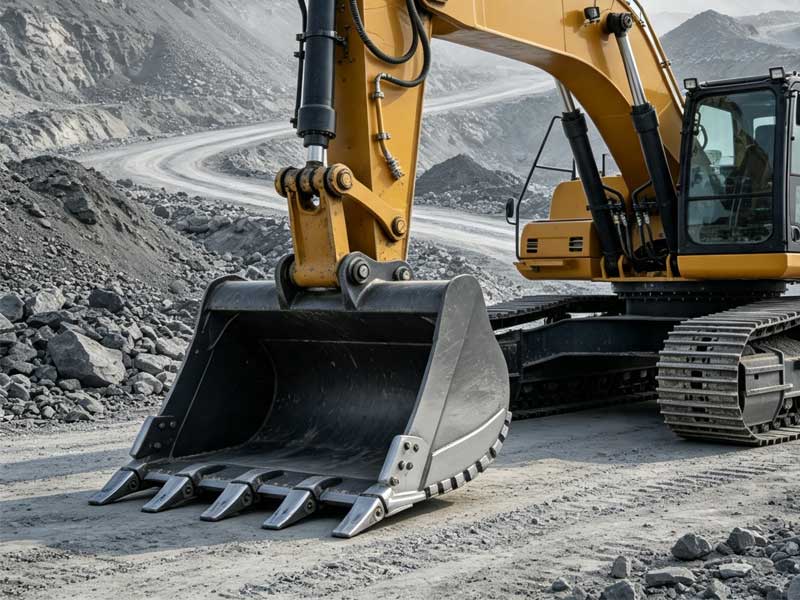
Excavator buckets are mostly backhoe style, designed for digging below ground level. They are graded by structural strength to match different material abrasion and impact loads.
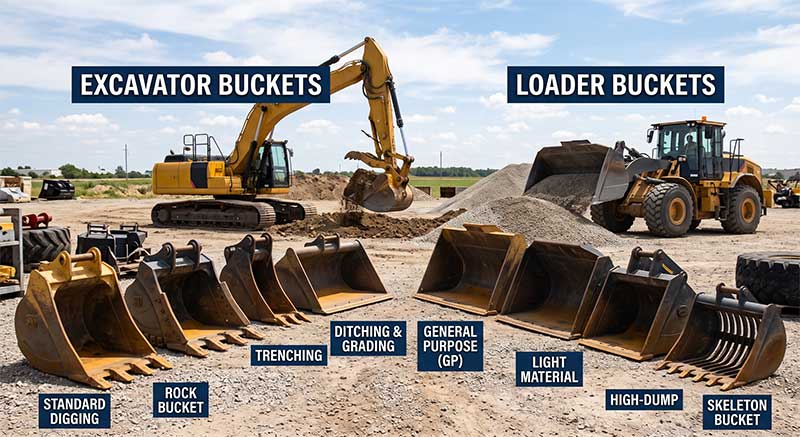
- – Standard (General‑purpose) Bucket: Built with ordinary structural steel Q345. Large opening area delivers high fill factor for clay, sand and gravel. Ideal for light earth‑moving tasks, low purchase cost but vulnerable under heavy impact loads.
- – Heavy‑Duty Reinforced Bucket: Critical wear zones adopt NM360 wear‑resistant steel with thicker plate thickness. Fits hard soil mixed with soft rubble, gravel loading with moderate shock and abrasion.
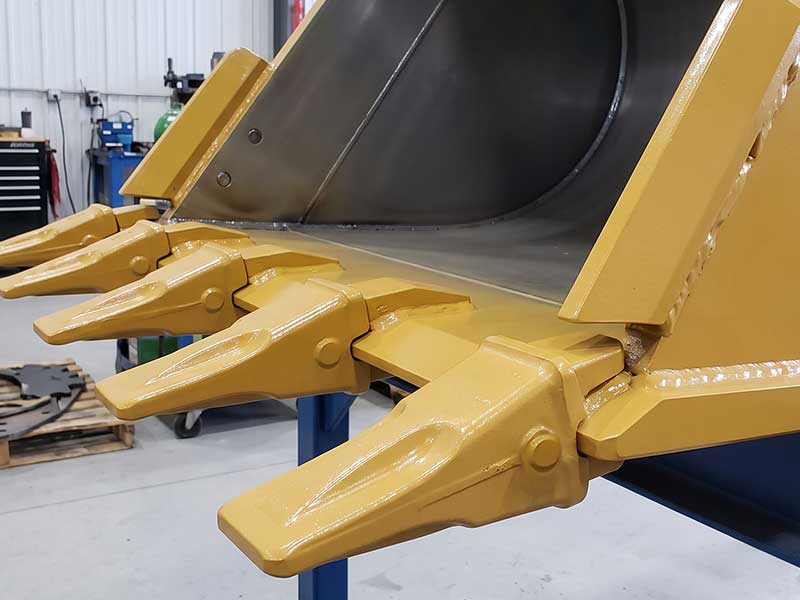
- – Rock Bucket: Fabricated from high‑strength wear‑resistant steel such as Hardox 450 or NM400. Reinforced bottom and side guard plates plus heavy‑duty bucket teeth deliver outstanding bending resistance for blasted rock, granite and quarry ore.
- – Special‑purpose Excavator Buckets:
– Ripping bucket: Sharp narrow teeth for breaking compact hard soil and weathered rock
– Cleaning / tilt bucket: Tooth‑less wide profile for dredging and slope finishing
– Ditch bucket: Rectangular or trapezoidal shape for one‑pass trench forming
– Skeleton bucket: Mesh bottom to separate stones, roots while digging
2. Main Categories of Loader Buckets
Loader buckets focus on forward crowding, scooping and material transportation. Design priority lies in crowding resistance and fill efficiency.
- – Standard Loader Bucket: Flat‑bottom universal design for earth, sand and aggregate handling.
- – Rock Loader Bucket: Reinforced construction, side cutter and heavy‑duty teeth. V‑edge variant reduces penetration resistance for blocky stone.
- – Light‑Material High‑Capacity Bucket: Enlarged volume with relatively light plate weight, for low‑density cargo including coal, grain and wood chips.
- – Side‑Discharge Bucket: Lateral dumping function for tunnel and confined‑space operation.
- – Loader Bucket with Wear‑resistant Edge Protector: Replaceable secondary cutting edge protects main blade and paved concrete ground, widely used at ports and batching plants.
- – Sieve bucket, log grapple: Special attachments for material screening and timber handling.
Table 1: Wear‑Resistant Steel Material Performance Reference for Buckets
| Steel Grade | Hardness HB | Typical Application | Relative Service Life vs Q345 | Remarks |
|---|---|---|---|---|
| Q345B | ~150 | General earth‑moving bucket body, low‑abrasion light‑material bucket | 1× | Low cost, not for impact‑heavy rock conditions |
| NM360 | 360‑400 | Reinforced bucket edges, side cutters, medium‑abrasion aggregate sites | 2‑3× | Cost‑effective for most construction scenarios |
| NM400 | 400‑440 | Rock bucket side & bottom plates, quarry heavy‑duty GET parts | 3‑4× | Domestic high‑grade wear plate for mining |
| Hardox 450 | 425‑475 | Severe‑impact rock bucket, mining excavator bucket | 3‑5× | Import premium wear‑resistant steel for extreme working conditions |
Industry note: Premium wear‑resistant steel raises bucket procurement cost by roughly 30‑50%, yet cuts downtime and repair expense significantly in heavy‑wear jobsites.
3. Core Bucket Selection Principles
Bucket selection is not simply chasing larger volume or thicker steel plates. Three core dimensions shall be evaluated: material density & hardness, working environment, and material & accessory configuration.
3.1 Practical Loader Bucket Capacity Formula
Recommended Bucket Capacity ≈ (Machine Rated Payload ÷ Material Bulk Density) × 0.85
The 0.85 safety coefficient avoids machine overloading and stability risk. Heavier materials require smaller bucket volume; low‑density materials allow expanded bucket size.
3.2 Material bulk‑density reference values:
- – Sand & gravel: 1.6‑1.8 t/m³
- – Blasted rock & ore: 2.1‑2.3 t/m³
- – Coal & light bulk cargo: 0.8‑0.9 t/m³
3.3 Working‑Environment Judgement
- – Digging below ground (foundation pit, trench): Backhoe bucket (standard for excavators)
- – Digging above bench height in quarry: Front‑shovel bucket improves cycle efficiency
- – Paved concrete yard: Specify secondary wear edge to prevent ground damage
- – Narrow tunnel / cabin operation: Side‑discharge loader bucket is preferred
3.4 Critical Accessory Choices
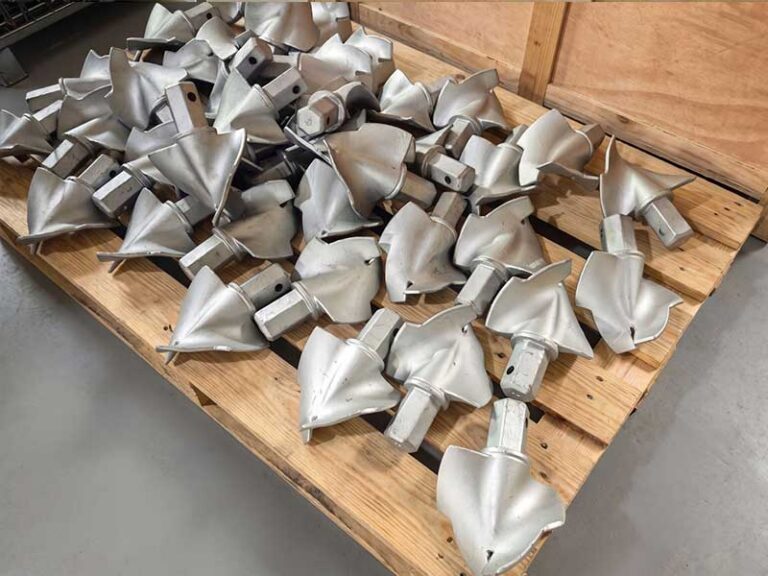
- – Bucket teeth: Split‑type tooth design allows only tip replacement after abrasion, cutting maintenance expense. One‑piece teeth need full assembly replacement. Rock‑condition jobs select rock teeth with penetrating tooth seats to avoid seat fracture.
- – Quick coupler: Shorten attachment swap time from hours to within 15 minutes for frequent bucket switching.
- – Replaceable side cutter guards: Protect bucket side walls, reduce body welding repair frequency.
Table 2: Scenario‑Based Bucket Configuration Reference (20t /30t Excavator & 3t /5t Loader)
| Equipment | Working Material | Suggested Bucket Capacity | Recommended Key‑part Material | Core Selection Tip |
|---|---|---|---|---|
| 20‑ton Excavator | Hard rock / blasted stone | 0.8‑1.0 m³ | Hardox450 / NM400 | Choose conservative capacity; add grid‑shaped bottom reinforcement |
| 20‑ton Excavator | Sand & gravel | 1.0‑1.2 m³ | NM360 + Q345B | Balanced efficiency & service life |
| 20‑ton Excavator | Coal / light bulk | 1.6‑1.8 m³ | Light‑weight Q345B | Wide‑mouth shallow‑profile bucket design |
| 30‑ton Excavator | Hard rock / blasted stone | 1.2‑1.4 m³ | Hardox450 / NM400 | Reduce capacity to 1.0‑1.1 m³ if rock block >600 mm |
| 30‑ton Excavator | Sand & gravel | 1.6‑1.8 m³ | NM360 + Q345B | Optimal balance for fuel consumption & output |
| 3‑ton Loader | Hard rock aggregate | 1.5‑1.7 m³ | NM360 edge + Q345B body | Avoid >1.8 m³ to prevent rear‑wheel lifting |
| 3‑ton Loader | Batching‑plant sand aggregate | 1.8‑2.0 m³ | NM360 secondary edge mandatory | Secondary edge thickness 14‑16 mm for ground protection |
| 3‑ton Loader | Coal / grain | 2.8‑3.2 m³ | Light‑weight Q345B | Max limit ≤3.5 m³ |
| 5‑ton Loader | Hard rock aggregate | 2.2‑2.5 m³ | NM360 edge + Q345B body | V‑shape cutting edge for better penetration |
| 5‑ton Loader | Batching‑plant sand aggregate | 2.8‑3.0 m³ | NM360 secondary edge mandatory | Do not exceed 3.0 m³ payload limit |
| 5‑ton Loader | Coal / light bulk | 4.5‑5.0 m³ | Light‑weight Q345B | Shallow‑wide bucket profile for high fill factor |
| 5‑ton Loader | Mixed construction debris | 2.5‑2.8 m³ | NM360 edge + Q345B body | All‑round universal bucket specification |
4. Three‑Question Quick‑Selection Checklist for B2B Buyers
- 4.1. What machine model? (Excavator / Loader plus operating weight or rated payload) → Lock baseline bucket capacity range
- 4.2. What material will you handle? Hard rock, gravel‑soil mix, coal‑light‑bulk, mixed debris → Confirm bucket grade: rock / heavy‑duty / light‑material bucket
- 4.3. Is the operating ground paved concrete or raw mine soil? → Decide whether secondary wear‑resistant edge is required.
Table 3: OEM & ODM Custom Bucket Advantage for Overseas Buyers
| Common Customer Pain Point | TrueCast Engineering Solution | Sample Sales Messaging |
|---|---|---|
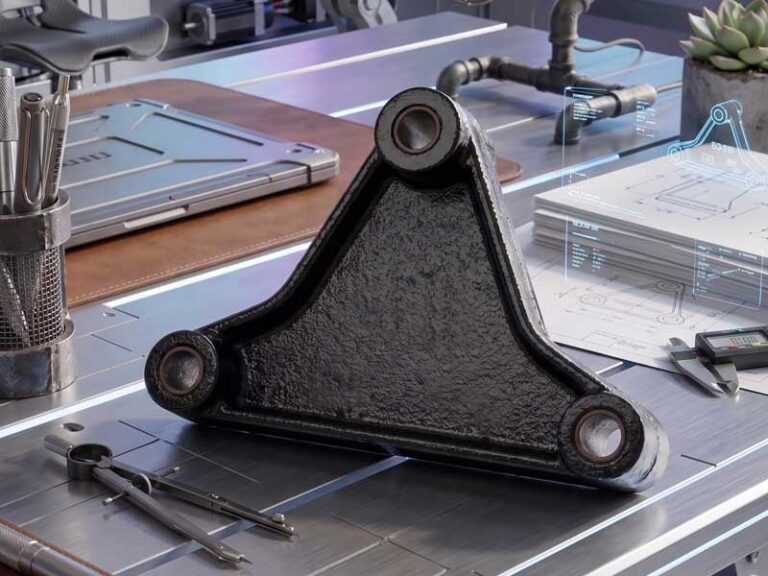
| Aftermarket bucket mismatches original pin‑hole dimensions, requiring on‑site modification | OEM 1:1 replication with drawings or 3D scanning, perfect fit for machine mounting | Send us your old bucket photos or drawing, we produce 1‑to‑1 OEM buckets, guaranteed mounting compatibility. |
| Wish to upgrade steel grade but standard mass‑produced products cannot satisfy | ODM customizable material grade & plate thickness, small‑batch production available | Hardox 500, NM450 or custom plate thickness are available, no need to wait for full container mass order. |
| Only need small quantity of special‑size buckets, large factories decline small orders | Low minimum order quantity, MOQ starts from 1 unit, faster lead‑time | We accept small‑batch custom buckets starting from one piece, delivery cycle much shorter than large OEM factories. |
Overseas dealers, rental companies and project contractors can leverage OEM & ODM custom bucket service to resolve non‑standard dimension and special‑working‑condition requirements, gaining advantages over generic mass‑market suppliers. When placing orders, verify bucket teeth compatibility, side‑cutter protection options and quick‑coupler interface to lower long‑term maintenance costs.