


Hydraulic Breaker Chisels Types & Selection Guide
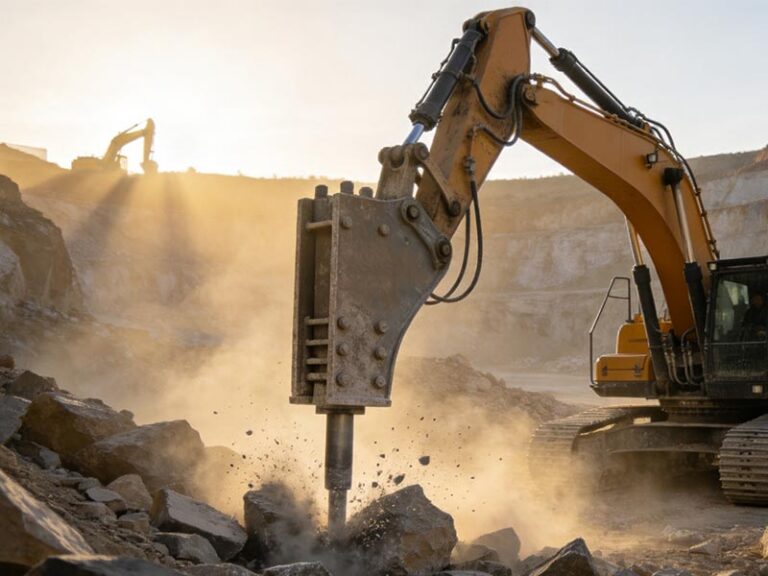
Hydraulic breaker chisels are one of the highest-consumption attachments for excavator breakers in demolition, quarrying and road construction projects. Many buyers only compare upfront price when sourcing breaker spare parts, ignoring geometry, steel grade and heat treatment standards that decide service life and breaking performance. This guide covers mainstream hydraulic breaker chisel types, core production workflow, typical job-site applications and a practical selection framework for OEM and aftermarket procurement from TrueCast Engineering.
1. Main Types of Hydraulic Breaker Chisels & Suitable Working Conditions
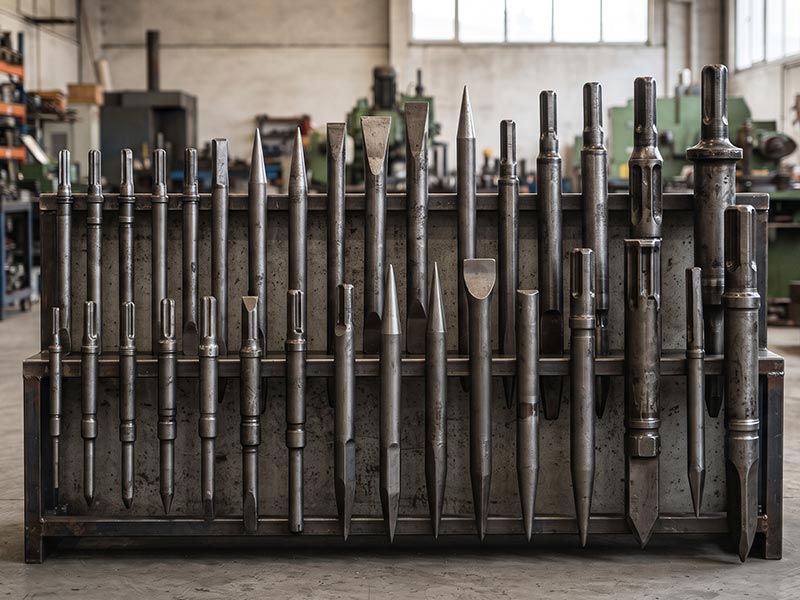
Four geometries dominate the global hydraulic breaker chisel market: moil point, blunt chisel, flat chisel and wedge chisel. Each shape creates different stress distribution under impact, so mismatched chisel selection leads to fast tip mushrooming, shank cracking and low blow efficiency.
| Chisel Type | Working Principle | Primary Applications | Limitations |
|---|---|---|---|
| Moil Point | Concentrates impact force on a narrow conical tip to initiate deep cracking | Hard rock, granite, basalt, reinforced concrete, primary breaking | Wears quickly in highly abrasive rock; poor for soft asphalt |
| Blunt Chisel | Distributes compression stress over a flat truncated face, low penetration | Secondary boulder breaking, fractured rock, limestone, slag recycling | Not ideal for solid monolithic rock needing penetration |
| Flat Chisel | Straight cutting edge for directional slicing | Asphalt removal, concrete slab demolition, trenching, foundation stripping | Less effective on dense hard rock, easy to twist under side load |
| Wedge Chisel | Wide splitting edge that forces material apart along fracture planes | Rock splitting, frozen soil, wall demolition, controlled breaking | Requires stable feed; side pry force accelerates bushing wear |
According to field operation statistics, moil point hydraulic breaker chisels account for roughly 62% of aftermarket breaker tool sales, as they serve mixed demolition fleets handling varied materials daily.
- Blunt tools take around 21% of demand, mostly from quarry sites for secondary breaking of oversized rocks.
- Flat and wedge chisels make up the remaining share for road renovation and trenching contracts.
- Special custom styles including spade chisels and carbide-tipped variants are available for niche OEM orders at TrueCast Engineering.
2. Manufacturing Process & Material Standard for High-Performance Hydraulic Breaker Chisels
A reliable hydraulic breaker chisel relies on matched alloy steel and gradient heat treatment, not simple forging only.
Low-cost aftermarket chisels often use uniform hardness across the whole bar; this causes either fast tip wear or sudden shank breakage under repeated impact shock.
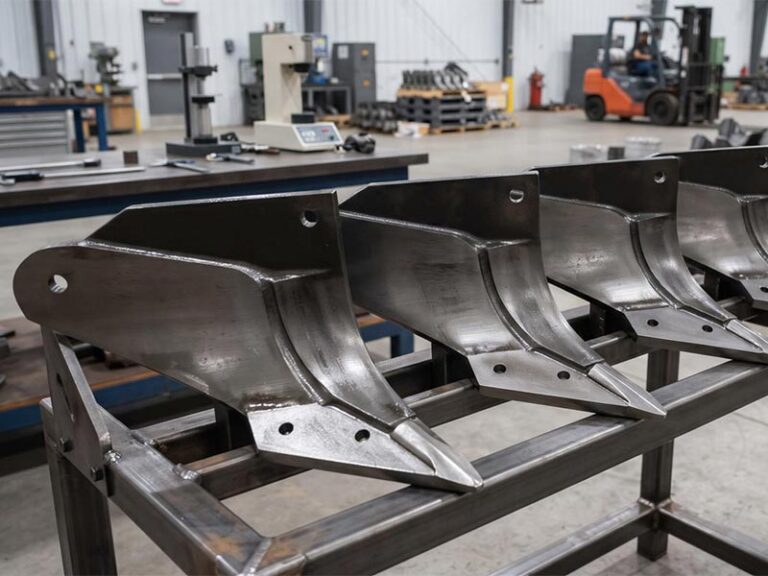
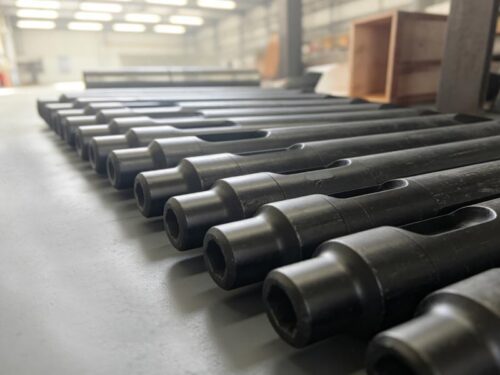
The standard production flow for our hydraulic breaker chisels is: raw material inspection → bar cutting → closed-die forging → rough machining → quenching + tempering → induction surface hardening → finish grinding → groove & pin hole machining → hardness testing → surface treatment and quality marking.
| Common Steel Grade | Typical Hardness Range | Core Advantage | Best Fit |
|---|---|---|---|
| 42CrMo Alloy Steel | Tip HRC 55–58, Shank HRC 42–46 | Balanced toughness and wear resistance, stable under cyclic impact | General moil, flat and wedge hydraulic breaker chisels |
| 40CrNiMo | Tip HRC 56–60, Shank HRC 44–48 | Higher impact fatigue resistance, anti-cracking | Heavy-duty quarry blunt chisels for large breakers |
| S7 Shock-Resistant Tool Steel | Tip HRC 54–57, Shank HRC 40–45 | Excellent anti-chipping performance | High-frequency demolition, high-shock working cycles |
The gradient hardness design is the key technical benchmark: the working tip gets higher surface hardness to resist abrasive wear, while the shank section retains lower hardness and higher toughness to absorb hammer impact without brittle fracture.
Third-party industry testing shows properly heat-treated 42CrMo hydraulic breaker chisels deliver 30% longer average life than non-gradient hardened alternatives under identical rock breaking cycles.
3. Typical Applications & Expected Service Life Benchmark
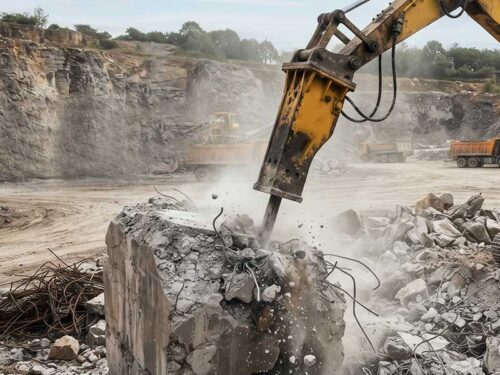
Hydraulic breaker chisels run across four major sectors: quarrying, building demolition, highway & municipal engineering, and mining auxiliary breaking.
Actual usable hours vary dramatically based on target material, operator technique and regular lubrication of the breaker bushing.
| Working Scenario | Average Service Life (Quality OEM Chisel) | Main Failure Mode | Recommended Chisel Type |
|---|---|---|---|
| Hard rock quarry (granite, basalt) | 200–400 operating hours | Tip abrasion, chipping | Moil point / blunt chisel |
| Reinforced concrete demolition | 400–800 operating hours | Tip rounding, shank fatigue | Moil point / flat chisel |
| Asphalt & soft limestone road work | 800–1200 operating hours | Edge wear, deformation | Flat chisel / wedge chisel |
| Frozen ground & secondary boulder reduction | 350–600 operating hours | Mushroomed tip | Blunt chisel |
One critical statistic from fleet maintenance reports: poor operating practice reduces hydraulic breaker chisel life by up to 70%. Holding the breaker in one fixed spot continuously longer than 20–30 seconds overheats the tip, softens the steel microstructure and triggers rapid failure.
Rotating the hydraulic breaker chisel 180° every 4–6 working hours evenly distributes circumferential wear and extends usable life by 20–30%, a simple maintenance tip shared with all TrueCast Engineering wholesale customers.
4. How to Select Hydraulic Breaker Chisels for Your Project
Correct hydraulic breaker chisel selection follows four decision layers: breaker compatibility, material hardness, breaking objective and total cost of ownership. Many buyers fixate on diameter matching while ignoring geometry and material grade, which creates frequent replacement cycles and extra labor cost.
First, confirm breaker model and nominal tool diameter.
Shank diameter, pin groove position and overall length must match your hydraulic breaker’s front head and bushing assembly. Even a 0.5 mm tolerance error will cause galling, bushing damage and side load on the hydraulic breaker chisel during impact. Always share breaker part numbers or dimension drawings for OEM matching when sending inquiries.
Second, match chisel shape to your material.
Use moil point hydraulic breaker chisels for solid hard rock and thick reinforced concrete where penetration is the priority. Select blunt chisels when you need to crush pre-cracked boulders instead of drilling new fractures. Flat chisels work best for slicing asphalt and concrete slabs, while wedge chisels are optimized for controlled splitting along natural rock lines.
Third, specify steel grade and heat treatment based on duty cycle.
If your machine runs two shifts daily in granite quarrying, upgrade to 40CrNiMo hydraulic breaker chisels rather than standard 42CrMo to cut consumption frequency. For light municipal jobs with asphalt and soft concrete, standard 42CrMo offers the most balanced value.
Fourth, evaluate total cost instead of unit price.
A cheap hydraulic breaker chisel at 40% lower price that wears out in 150 hours creates higher downtime and labor cost than a premium OEM-grade part lasting 500+ hours.
As a professional excavator wear parts supplier, TrueCast Engineering supplies fully customized hydraulic breaker chisels, breaker bushings and pin kits compatible with most mainstream hydraulic hammer brands. Contact our engineering team to send your drawing list for quotation and lead time confirmation.
FAQ
Q1: Can I weld and re-harden a worn hydraulic breaker chisel on site?
A: No. Welding destroys the calibrated heat treatment layer and creates hidden fatigue cracks, which may lead to sudden fracture during impact and safety risks.
Q2: Does every hydraulic breaker chisel fit all breakers with the same shank diameter?
A: No. Groove spacing, shank length and shoulder profile vary across brands; dimension verification is mandatory before ordering.
Q3: What is the fastest sign to replace a hydraulic breaker chisel?
A: Replace immediately when the tip wears down by more than 15–20% of original diameter, mushrooming appears, or linear cracks form near the pin groove.