


Log Loader Rotating Grapple Manufacturing & Selection Guide
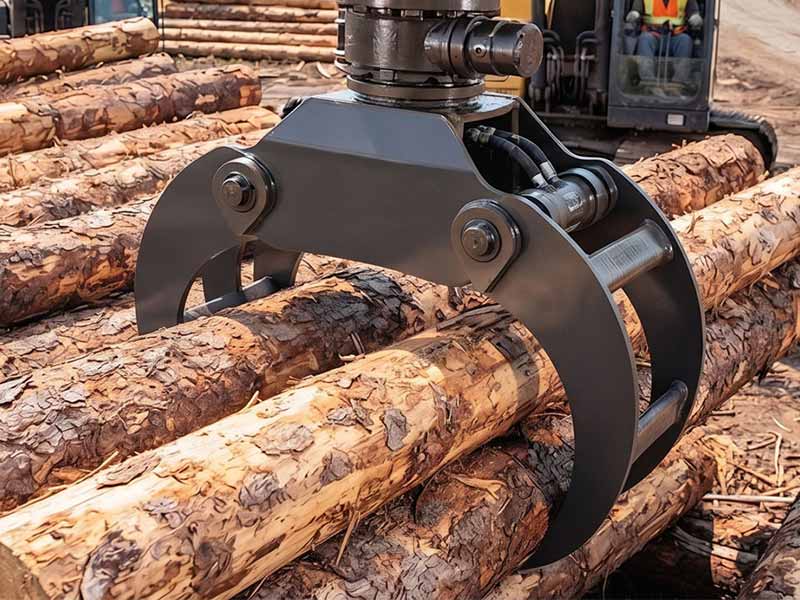
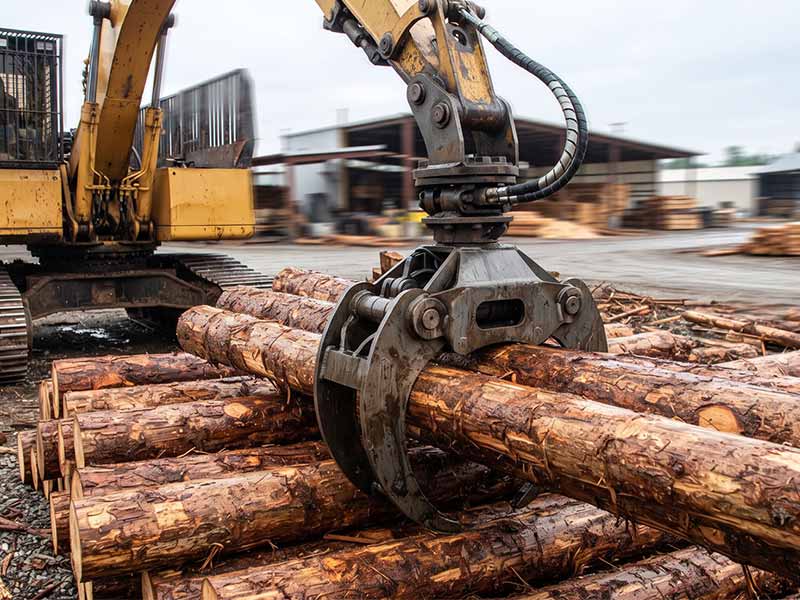
The log loader rotating grapple is a heavy-duty hydraulic attachment engineered for forestry harvesting, sawmill yards, pulpwood processing and biomass cleanup.
Mounted on log loaders, excavators or knuckleboom cranes, this attachment delivers continuous 360° hydraulic rotation together with powerful jaw clamping force to grab, rotate, sort, stack and load logs efficiently.
1. Global Market Trends for Log Loader Rotating Grapple
The global log grapple market reached USD 654.78 million in 2025 and is projected to hit USD 929.65 million by 2032 at a CAGR of 5.12%, with rotating log grapples representing one of the fastest-growing subsegments at a CAGR of 6.3% through 2032. Operators are steadily replacing fixed grapples with rotating models because 360° rotation removes the need to reposition the host machine for log orientation, cutting loading cycle times significantly.
3 Core trends are reshaping procurement decisions for log loader rotating grapple buyers:
- 1. Lightweight high-strength construction: OEMs adopt premium wear-resistant steel to reduce dead weight while preserving clamping and impact resistance. This improves host machine payload and fuel efficiency without sacrificing service life.
- 2. Integrated hydraulic and sensor technology: Premium models use valve-on-swivel designs to minimise hose twisting, while telematics sensors track operating hours, load pressure and component wear for predictive maintenance.
- 3. Multi-purpose adoption: Modern log loader rotating grapple designs now handle pulpwood, forest residue, storm debris and scrap timber beyond traditional saw logs, increasing ROI for mixed-operation fleets.
Table 1: Global Log Grapple Market Overview (2025–2032)
| Metric | Value |
|---|---|
| 2025 Market Size | USD 654.78 Million |
| 2032 Forecast | USD 929.65 Million |
| Overall CAGR | 5.12% |
| Rotating Log Grapple Segment CAGR | 6.30% |
| Leading Application | Forestry Logging (65.5%) |
| Leading Region | North America |
2. Main Types of Log Loader Rotating Grapple
Different log loader rotating grapple jaw geometries serve distinct timber sizes and working environments. Choosing the correct grapple style reduces log slippage and structural stress during daily operation.
Bypass Grapple
Bypass grapple jaws interlock when closed. The crossed jaw design creates tight contact for single logs and small-diameter timber, minimising gaps. This is ideal for thinning operations, small saw logs and clean log sorting.
Non-Bypass / Box Style Grapple
Non-bypass grapple jaws close face-to-face rather than interlocking. The rigid box frame delivers excellent torsional resistance for heavy, large-diameter hardwood logs and messy log piles. It handles high impact loads better than bypass models.
Pulpwood / Bunching Grapple
Optimised curved jaw profiles allow operators to grab multiple short pulpwood stems in one cycle. This log loader rotating grapple variant is widely used in pulp mills and biomass collection yards to maximise bundle loading throughput.
Table 2: Log Loader Rotating Grapple Type Comparison
| Grapple Type | Best For | Core Strength | Limitation |
|---|---|---|---|
| Bypass Grapple | Small diameter logs, single stem handling | Tight closure, low log slip | Less resistance against heavy twisted loads |
| Non-Bypass Box Style | Large hardwood logs, tangled log piles | High torsional rigidity, heavy impact tolerance | Slight gaps when grabbing thin single stems |
| Pulpwood Bunching Grapple | Short pulpwood, biomass bundles | High volume bunching speed | Poor for large single timber |
3. Material Selection for Log Loader Rotating Grapple
A log loader rotating grapple works under continuous shock load, abrasion, moisture, resin and freeze-thaw cycles. Material grade determines service life and downtime frequency.
- – Main jaw & frame: AR400, AR500 or Hardox wear-resistant steel. These grades deliver high hardness and crack resistance under repeated log impact. TrueCast Engineering uses NM400 / NM500 wear steel options for custom cast and fabricated grapple bodies.
- – Pins and bushings: Heat-treated alloy steel with induction hardening and chrome plating. Self-lubricating composite bushings reduce friction at pivot joints and extend pin life.
- – Rotator and slew assembly: Heavy-duty hydraulic rotator with built-in overload relief valves and reinforced slew bearing, engineered to absorb offset loading from uneven log grabs.
Table 3: Material Performance Reference for Log Loader Rotating Grapple Components
| Component | Standard Material | Hardness | Key Benefit |
|---|---|---|---|
| Grapple Jaws & Main Frame | AR500 / NM500 | 470–530 HB | Excellent abrasion and impact resistance |
| Pivot Pins | Alloy Steel, Induction Hardened | HRC 52–58 | Wear resistance and bending strength |
| Bearing Bushings | Bronze / Self-lubricating Composite | N/A | Reduces grease frequency and pin wear |
| Rotator Housing | High Strength Cast Steel | 280–340 HB | Resists continuous torsional rotation load |
4. Manufacturing Process
TrueCast Engineering follows a structured production workflow backed by FEA simulation before cutting any steel, to eliminate stress concentration points.
- 1. CAD & FEA finite element analysis: Engineers simulate jaw clamping force, torsion and impact load to refine structural geometry and avoid failure hotspots.
- 2. CNC laser / plasma cutting and edge bevelling: Precision cut plate with accurate weld preparation ensures consistent weld penetration.
- 3. Robotic welding: Critical load-bearing joints use robotic welding to achieve full penetration, low porosity and repeatable weld quality. Manual finishing welds for complex corners.
- 4. Post-weld stress relief: Heavy fabrications go through stress relief to minimise distortion under cyclic loading.
- 5. Surface preparation and coating: Shot blasting removes mill scale and rust, followed by epoxy primer and durable polyurethane topcoat for protection against resin, mud and weather corrosion.
- 6. Assembly and pressure testing: Pins, bushings, hydraulic rotator and cylinders are fitted, then full hydraulic pressure and rotation testing verify leak-free performance before shipment.
5. Application of Log Loader Rotating Grapple
The log loader rotating grapple serves multiple heavy material handling workflows:
– Forest landing sites: Sort, collect and load harvested logs onto log trucks.
– Sawmill and timber yards: Unload incoming timber, stack high-volume log inventory and feed logs to debarkers and conveyors.
– Pulp and paper mills: Handle bundles of short pulpwood.
– Biomass and land clearing projects: Collect branches, slash and wind-thrown trees.
– Storm damage cleanup and waste timber recycling.
6. Log Loader Rotating Grapple Selection Guide
Matching the log loader rotating grapple to your host machine and material profile is critical to avoid tipping risk, weak clamping or premature rotator failure.
1. Host machine capacity matching:
The total weight of grapple plus full log load must stay within the log loader or excavator’s rated lifting capacity. Overweight attachments reduce stability and shorten boom life.
2. Hydraulic circuit requirements:
The carrier needs dual auxiliary hydraulic circuits: one for jaw open/close, a separate circuit for continuous rotator drive. Confirm flow and pressure match grapple specifications.
3. Log diameter and pile condition:
- Small, clean logs → bypass log loader rotating grapple.
- Large hardwood and messy piles → non-bypass box style.
- Short pulpwood bundles → bunching grapple.
4. Working environment:
For abrasive, cold or resin-heavy operations, upgrade to AR500 jaw plates and high-performance coated pins.
7. Maintenance & Care for Log Loader Rotating Grapple
Proactive maintenance can double the service life of your log loader rotating grapple and reduce unplanned downtime.
- – Grease schedule: Lubricate all pivot joints every 50 working hours (or weekly) with extreme-pressure lithium grease. Skipping lubrication causes pin seizure and bushing wear.
- – Hydraulic inspection: Check rotator swivel joints, hoses and cylinder seals for abrasion, twisting and oil leaks. Route hoses properly to avoid pinching during full jaw travel.
- – Weld and structural inspection: Visually inspect main frame, jaw welds and rotator mounting flange for cracks after heavy impact events. Repair small cracks immediately to prevent catastrophic failure.
- – Bolt retorque: Recheck slew ring and cylinder mounting bolts with a torque wrench at scheduled intervals; vibration gradually loosens fasteners.
- – Rotator health monitoring: Listen for unusual noise during rotation. Monitor hydraulic pressure to identify internal rotator wear before breakdown.
Final Thoughts
The log loader rotating grapple remains a core investment for forestry and timber handling businesses aiming to boost throughput and operator safety.
With correct type selection, premium wear-resistant materials, robust manufacturing and routine maintenance, this attachment delivers reliable performance in harsh forestry and mill yard conditions.
TrueCast Engineering provides custom OEM and standard log loader rotating grapple solutions tailored for log loaders, excavators and knuckleboom cranes for global forestry clients.