


Understanding Bucket Teeth: How to Reduce Wear and Tear in Mining Excavators
As high-frequency wear parts, Mining Excavator bucket teeth withstand extreme mechanical forces throughout daily operation, making their durability and working status directly tied to overall mining efficiency and operational costs.Unplanned fracture, excessive abrasion, and premature failure of bucket teeth are not merely spare parts replacement expenses.
Industry data shows that the global mining bucket tooth market reached $4.2 billion in 2025 and is projected to exceed $4.5 billion in 2026 with a 6.8% annual growth rate.
More critically, unexpected bucket tooth failures cause unplanned equipment downtime, which accounts for 30–40% of total mining operational losses in mid-to-large mining enterprises.
Additionally, improper bucket tooth matching and maintenance will increase excavator fuel consumption by 8–15% and accelerate hydraulic system aging, forming a hidden long-term cost burden for mine operations.
This article systematically analyzes the structural mechanics, operational challenges, core material and process standards, model selection logic, and maintenance specifications of mining bucket teeth from the perspectives of engineering mechanics and material science.
It aims to provide data-backed, professional decision-making basis for mine operators, equipment supervisors, and mechanical maintenance engineers to help them achieve scientific model selection, standardized maintenance, and precise cost control.
1. Anatomy of a Bucket Tooth System
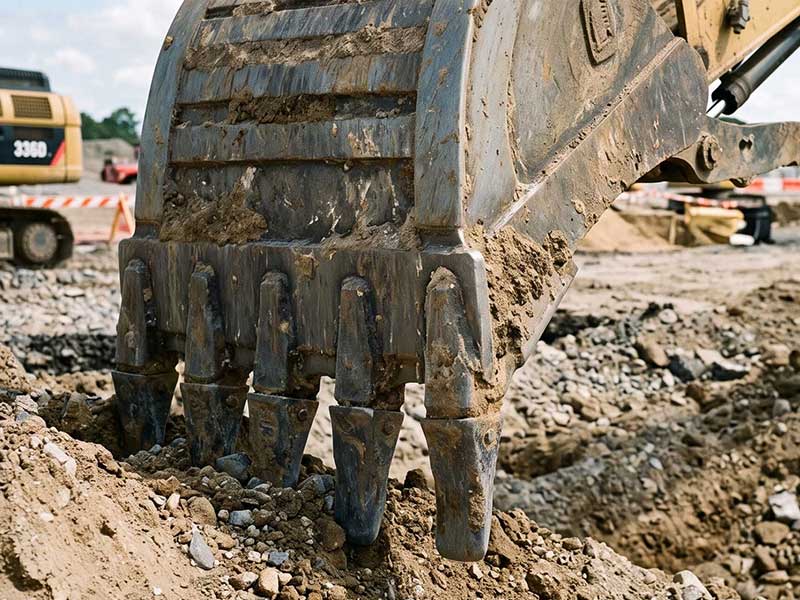
The mining bucket tooth system is not a single metal component but a complete force-bearing and wear-resistant assembly with a layered force transmission structure.
Each part undertakes independent functional responsibilities and cooperates to resist complex working conditions such as impact, friction, and torsion. A standardized bucket tooth system consists of three core parts:
1.1 Tooth Point/Tip
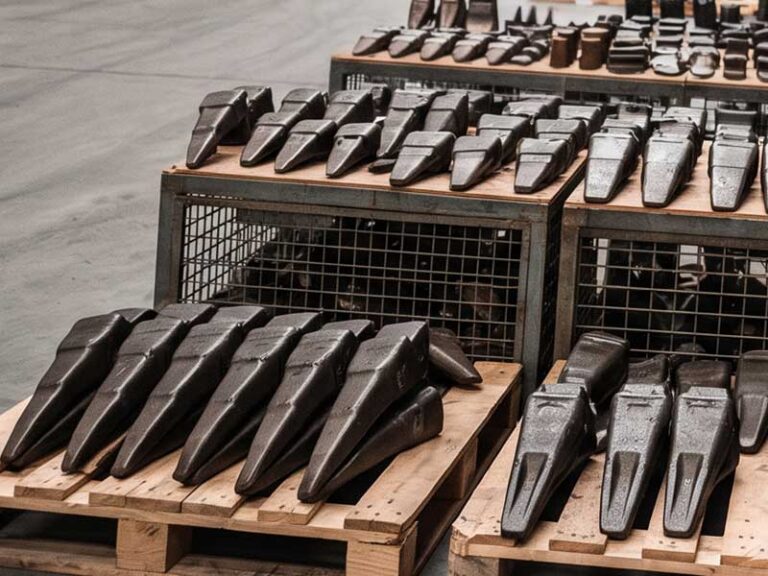
As the direct working component of the entire system, the tooth point is the first to contact ore, rock, and soil.
It undertakes all cutting, penetration, and stripping work during excavation, bearing high-strength abrasive friction and instantaneous impact load.
It is the fastest-wearing and most replaceable core consumable part of the assembly.
1.2 Adapter
The adapter is fixedly welded to the lip of the excavator bucket, serving as the fixed base of the tooth point.
Its core function is to disperse the concentrated impact force and friction force borne by the tooth point, transmit the mechanical load evenly to the overall bucket structure, and avoid local stress concentration leading to bucket lip deformation or cracking.
Unlike wearable tooth points, adapters are long-term structural parts, and their damage is often caused by long-term mismatched tooth models or excessive wear of tooth points.
1.3 Locking System (Pin & Retainer)
The locking system composed of pins and retainers is the key to ensure the stable connection between the tooth point and the adapter, preventing tooth shedding under multi-directional alternating force.
At present, the mainstream locking structures in the market are divided into transverse pin and longitudinal pin types, with obvious differences in applicable scenarios and stability.
The comparative analysis is shown in the table below:
|
Locking Type
|
Structural Features
|
Operational Advantages
|
Limitations & Applicable Scenarios
|
|---|---|---|---|
|
Transverse Pin
|
The pin penetrates horizontally through the tooth body and adapter, fixed with external circlip
|
Simple disassembly and replacement, low maintenance time cost, universal compatibility
|
Weak resistance to extreme impact, easy pin loosening in hard rock mining; suitable for earthwork stripping, gravel, and medium-low abrasion working conditions
|
|
Longitudinal Pin
|
Vertical penetration locking structure, with built-in limit design
|
Strong anti-torsion and anti-loosening ability, stable connection under high impact load
|
Complicated replacement process and high maintenance requirements; suitable for hard rock, iron ore, and high-impact mining scenarios
|
2. Engineering Challenges in Mining Working Conditions
Mining working conditions are far more harsh than ordinary earthwork operations. Complex geological environments and high-intensity cyclic operations bring three major persistent engineering challenges to bucket teeth, which are the fundamental causes of tooth wear, fracture, and failure.
2.1 High-Strength Abrasive Wear
Most mining raw materials such as quartz sand, iron ore, granite, and limestone have high hardness and sharp particle edges. These fine and hard ore particles continuously cut and scrape the surface of bucket teeth during repeated excavation, forming continuous abrasive wear similar to sandpaper polishing.
Statistical data shows that abrasive wear accounts for 65% of all bucket tooth failure cases, which is the primary factor leading to the thinning and scrapping of tooth bodies.
2.2 Extreme Instant Impact Load
In the process of stripping hard rock layers and shoveling blasted ore piles, bucket teeth will bear instantaneous impact pressure up to hundreds of megapascals. This cyclic impact load easily produces micro-cracks inside the metal material. With the accumulation of operation time, the micro-cracks expand and eventually lead to brittle fracture of bucket teeth.
Impact failure accounts for 25% of bucket tooth damage cases, and is the main cause of sudden unplanned downtime.
2.3 Rising Penetration Resistance & Derivative Losses
After the tooth tip is worn and passivated, the excavation penetration resistance increases exponentially. Blunt bucket teeth cannot efficiently cut ore, forcing the excavator to increase hydraulic pressure and engine power output.
According to mining equipment operation monitoring data, excessively worn bucket teeth will increase comprehensive fuel consumption by 10–18% and accelerate the fatigue aging of hydraulic cylinders, pipelines, and other core components, bringing implicit high maintenance costs for the whole machine.
3. Core Technical Indicators of High-Quality Bucket Teeth
The quality difference of mining bucket teeth essentially stems from material formula and processing technology.
There is an inherent balance contradiction between surface hardness (wear resistance) and internal toughness (fracture resistance) of metal materials.
High-quality bucket teeth rely on scientific material proportioning and precise process control to realize the optimal matching of performance. The core judgment standards are as follows:
3.1 Scientific Alloy Steel Composition Ratio
The trace elements in alloy steel determine the mechanical properties of bucket teeth fundamentally, and each element has a targeted functional orientation.
- Carbon (C) is the core element to improve metal hardness and wear resistance; excessive carbon content will reduce material toughness and cause brittle fracture.
- Manganese (Mn) can enhance the metal’s impact resistance and plasticity, effectively resisting cyclic impact deformation in mining.
- Molybdenum (Mo) stabilizes the metal internal structure, improves high-temperature resistance and fatigue resistance, and avoids performance attenuation under long-term high-load operation.
- Nickel (Ni) optimizes the comprehensive toughness of the alloy, reduces internal micro-defects, and improves the overall structural stability of bucket teeth.
3.2 Casting vs. Forging Process Comparison
Casting and forging are the two mainstream forming processes of bucket teeth, with essential differences in internal structure and mechanical properties, adapting to different mining cost and performance demands.
The detailed comparison is shown in the table below:
|
Processing Technology
|
Structural & Performance Characteristics
|
Cost & Service Life
|
Applicable Scenarios
|
|---|---|---|---|
|
Precision Casting (Lost Foam/ Water Glass Casting)
|
Supports complex tooth profile structure design, high dimensional accuracy, complete external forming; slight internal porosity exists
|
Low manufacturing cost, moderate service life, stable conventional wear resistance
|
Earthwork stripping, gravel mine, low-impact and high-abrasion conventional working conditions
|
|
Forging Forming
|
High internal metal density, compact structure without pores, excellent overall toughness and impact resistance, uniform internal stress distribution
|
High manufacturing cost, 30–50% longer service life than cast teeth, low failure rate
|
Hard rock, iron ore, high-impact and heavy-load mining working conditions
|
3.3 Heat Treatment: The Balance of Hardness and Toughness
Hardness and toughness are a pair of restrictive indicators for metal materials.
Higher surface hardness means stronger wear resistance but weaker impact toughness and easier fracture; excessive toughness will lead to low hardness and rapid wear.
Professional bucket tooth manufacturers rely on precise quenching and tempering processes to break through this contradiction.
Standard high-quality heat treatment process can make the tooth surface hardness reach HRC 58–62, meeting the high wear resistance demand; while the internal matrix maintains moderate toughness, realizing the optimal state of “hard surface for wear resistance and tough interior for fracture resistance”.
In addition, the industry’s new technical specification requires that by 2030, the average service life of mining bucket teeth will be increased from the current 800 working hours to 1500 working hours, which further raises the standard of heat treatment process.
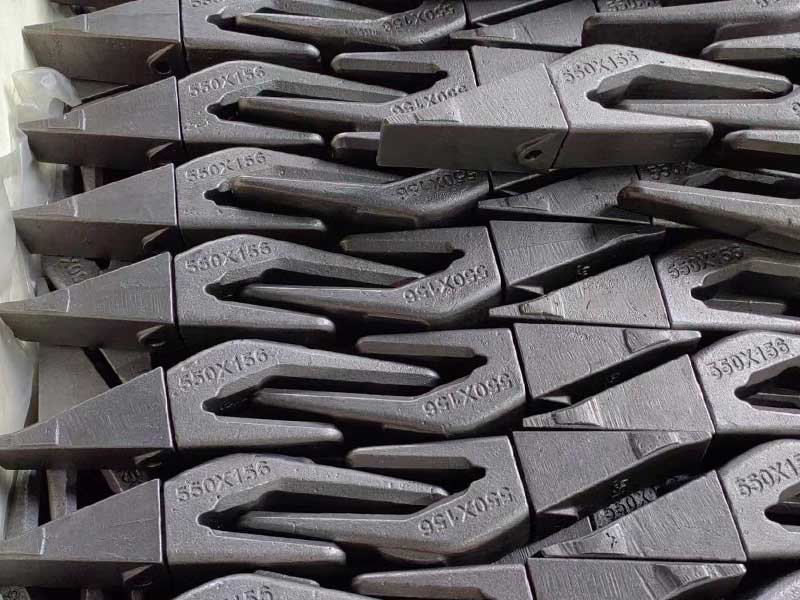
4. Bucket Tooth Profile Selection Guide by Geological Condition
There is no universal “best bucket tooth”, only the most matching one for specific working conditions.
Different tooth profile designs target different geological hardness, abrasion degree and impact intensity. Correct model selection can effectively reduce wear rate and avoid premature failure.
The applicable scenarios of mainstream tooth types are summarized as follows:
4.1 Rock Chisel / Rock Penetration Tooth
Featuring a sharp conical tooth tip and streamlined overall structure, this type has extremely strong penetration. It can quickly break compact hard rock and blasted hard ore piles, effectively reducing excavation resistance.
It is specially designed for high-hardness rock mining, mountain stripping, and high-impact working conditions, and is the preferred model for hard rock mines.
4.2 Heavy-Duty Abrasion Tooth
With a wider and thicker wear-resistant surface and enhanced tooth body thickness, it reduces the wear speed of the effective working surface.
It sacrifices partial penetration performance in exchange for ultra-high wear resistance, suitable for high-abrasion and low-impact working conditions such as sand and gravel mines, weathered gravel layers, and river dredging.
4.3 General-Purpose Tooth
Balancing penetration and wear resistance, with moderate tooth tip sharpness and tooth body thickness, it has comprehensive performance and strong adaptability.
It is suitable for conventional earthwork stripping, mild weathered rock, and mixed soil-rock working conditions, and is the most widely used universal model in open-pit mines.
4.4 Tiger / Twin Tiger Tooth
Adopting double-tip or ultra-sharp single-tip design, it has extreme penetration capability, which can efficiently break frozen soil layers, hard interlayers, and compacted ore bodies.
However, due to the narrow wear surface, the wear speed is faster than other models. It is mostly used in special working conditions such as frozen soil mining and hard interlayer stripping.
5. Daily Maintenance & Replacement Best Practices
Scientific daily maintenance and standardized replacement timing are key to extending the overall service life of the bucket tooth system and reducing comprehensive operating costs. Most mine equipment losses are caused by neglected minor maintenance and delayed replacement.
5.1 Regular Visual Inspection Standards
It is recommended to conduct a full inspection of the bucket tooth system before daily startup and after daily shutdown. The key inspection items include:
- Checking whether the locking pin and retainer are loose, displaced or missing;
- Observing whether there are micro-cracks, deformation or uneven wear on the tooth body;
- Detecting whether the welding seam of the adapter has cracking or peeling;
- And eliminating hidden dangers of falling teeth and fracture in advance.
5.2 Scientific Replacement Timing Criteria
It is a common misconception to replace bucket teeth only when they are completely worn flat. Excessive wear of tooth points will change the force-bearing structure of the adapter, leading to eccentric stress and accelerated wear of the expensive adapter.
The industry’s recommended replacement threshold is: when the effective height of the tooth tip is worn by more than 40%, or when the tooth tip penetration angle is completely passivated and the excavation resistance increases significantly, replace the tooth point in time. This can protect the adapter and reduce the overall replacement cost of the assembly.
5.3 Safety Operation Specifications for Replacement
During bucket tooth replacement, operators must wear protective goggles and anti-impact gloves to prevent metal spatter and pin popping from causing personal injury.
Before disassembly, completely release the excavator hydraulic pressure and stably place the bucket on flat ground to avoid equipment tipping.
After replacement, check the locking firmness repeatedly to ensure no virtual connection, and conduct no-load test operation before formal mining work.
6. Conclusion
Mining bucket teeth are not simple ordinary metal parts, but sophisticated wearable components integrating material science, mechanical mechanics and thermal processing technology. Its service status directly affects mine production efficiency, equipment maintenance costs and overall operating benefits.
Faced with the increasingly refined and high-efficiency development trend of the global mining industry, blind pursuit of low-cost accessories can only bring higher hidden downtime and maintenance losses.
Accurate working condition matching, scientific material and process identification, and standardized daily maintenance are the core keys to reducing bucket tooth wear and cutting mine comprehensive operating costs.
Truecasteng has long focused on the R&D, manufacturing and technical research of mining wear parts, accumulating rich practical experience in bucket tooth matching and maintenance for different geological and working conditions.
We insist on outputting professional industry popular science and practical technical solutions to help mine enterprises realize cost reduction and efficiency improvement. If you are evaluating the consumption of mine equipment wear parts, or need targeted bucket tooth model selection and maintenance suggestions for your mine’s geological conditions, feel free to contact our engineering support team for professional technical communication and customized solutions.