


Excavator Crusher Bucket: Market Trends & Selection Guide Tips
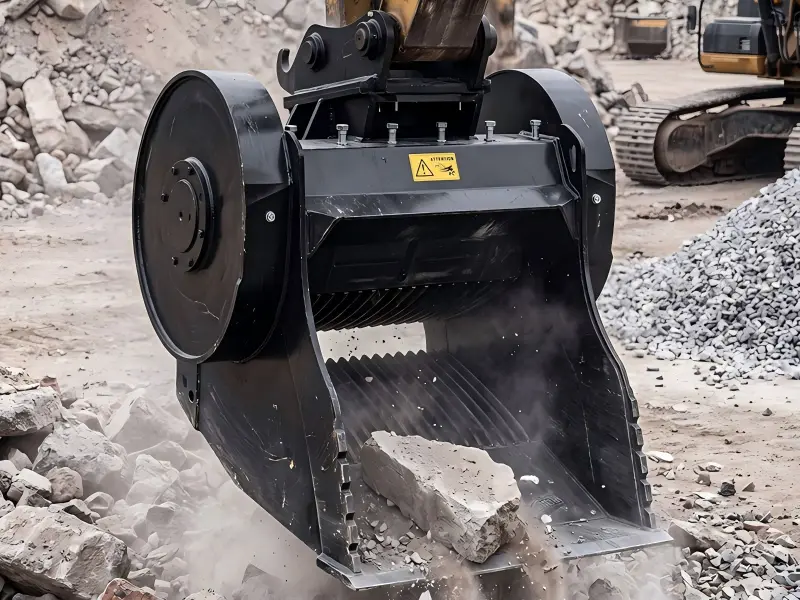
An excavator crusher bucket transforms a standard excavator into a mobile crushing unit, turning concrete, brickwork, asphalt and rock into reusable recycled aggregates directly on‑site.
On‑site material recycling continues to gain momentum across global demolition, road rehabilitation and mining support projects.
This article covers latest market developments, key performance benchmarks, multi‑tonnage selection reference and critical purchasing criteria for crusher bucket investments.
1. New Product Releases: Regional‑Optimized Crusher Buckets
Manufacturers are rolling out application‑tailored crusher bucket models for different geographic markets, focusing on throughput, hydraulic compatibility and maintainability.
ALLU launched its new concrete crusher bucket for Australia’s demolition market, engineered for 25‑45‑ton excavators. It delivers up to 100 tons per hour throughput, crushing incoming 300 mm concrete and brick material into qualified recycled aggregates. This solution eliminates multi‑step material haul‑away and off‑site crushing, streamlining demolition‑site workflows.
For European markets, MOTEK released the MTC250 crusher bucket optimized for 21‑32‑ton excavators. The design recalibrates hydraulic parameters to match mainstream European excavator platforms, prioritizing continuous running stability and reduced routine maintenance frequency.
Meanwhile, Chinese engineering manufacturers keep advancing integrated‑structure patents. By merging crushing and receiving functions into one unit, these designs cut intermediate handling steps, boost site productivity and lower overall project expenditure.
Global market research indicates two clear development directions for crusher bucket hardware: modular construction and advanced wear‑resistant material adoption.
Modular components simplify part replacement; high‑grade abrasion‑resistant steel extends service life under harsh site conditions. The core value proposition remains unchanged: on‑site waste recycling for demolition, tunnel and highway projects, cutting transportation and landfill expenses.
2. Key Market Statistical Data
Below tables compile public‑domain industry benchmarks, performance comparisons and excavator‑matching parameters for reference by procurement engineers.
Table 1: Global Excavator Crusher Bucket Market Core Metrics (2026)
| Metric | Value | Source Notes |
|---|---|---|
| Estimated global market size | USD 418.2 M | Research and Markets, industry report |
| CAGR (2026‑2031) | 6.4% | Driven by demolition & construction recycling regulations |
| Dominant application | Building demolition waste recycling | 62.7% of total market volume |
| Average hard‑rock crushing cost per ton | USD 4.0‑8.0 | Field operational benchmark data |
| Major manufacturing clusters | East China, Shandong, Henan | Leading OEM & export production hubs |
Table 2: Crusher Bucket Performance vs Centralized Mobile Jaw Crusher
| Evaluation Item | Excavator‑mounted Crusher Bucket | Trailer‑mounted Mobile Jaw Crusher |
|---|---|---|
| Typical hourly throughput | 15‑100 t/h | 150‑400 t/h |
| On‑site mobility | High (moves with excavator) | Medium (requires relocation transport) |
| Upfront capital investment | Low‑medium | High |
| Best‑fit scenario | Small‑medium jobs, scattered sites | Large‑volume fixed crushing yards |
| Limitation | Not cost‑effective for very high‑volume hard rock | High logistics cost for frequent site shifts |
Table 3: Excavator Tonnage — Crusher Bucket Selection Reference
| Excavator Operating Weight (ton) | Recommended Crusher Bucket Type | Required Hydraulic Flow L/min | Typical Working Pressure bar | Primary suitable material |
|---|---|---|---|---|
| 13‑18 | Light‑duty jaw crusher bucket | 80‑120 | 210‑260 | Concrete, brick, soft limestone |
| 21‑25 | Medium‑duty crusher bucket | 120‑160 | 240‑300 | Concrete, mixed construction debris |
| 25‑32 | General‑purpose heavy‑duty crusher bucket | 140‑180 | 260‑320 | Concrete, medium‑hard rock |
| 32‑45 | Heavy‑duty reinforced crusher bucket | 170‑220 | 280‑350 | Reinforced concrete, granite, basalt |
Note: Always cross‑check the attachment manufacturer’s official specification sheet. Quick‑coupler or pin‑on mounting dimensions must match host machine interfaces. For high‑abrasion rock conditions, specify Hardox 500 or equivalent high‑strength wear steel for jaw plates and shell structures.
3. Three Core Buying Decision Factors for Crusher Bucket Procurement
3.1. Precise Matching Between Attachment and Working Conditions
Incorrect matching causes low output, accelerated component wear and even permanent damage to the carrier excavator. Two matching dimensions must be verified before purchase.
Excavator host matching
Confirm excavator tonnage range, required hydraulic flow and working pressure. Mismatched hydraulic supply leads to slow crushing cycles or overheating. Confirm connection method: pin‑on connection or hydraulic quick‑coupler, verify bucket ear dimension, pin diameter and center distance.
Material matching
Classify incoming feed: construction concrete with rebar, soft limestone or high‑abrasion granite / basalt.
- – For reinforced concrete recycling: prioritize models with good rebar separation performance.
- – For hard rock applications: jaw plates and main body shall adopt premium wear‑resistant alloy steel.
3.2. Deep Evaluation of Total Cost of Ownership (TCO)
Smart buyers look beyond initial purchase price and calculate full‑lifecycle economics.
Cost per ton crushed
Total per‑ton cost sums wear‑part consumption (jaw plates, side liners), excavator extra fuel burn and hydraulic‑system wear risk. When processing large‑volume hard rock, crusher buckets lose economic advantage compared with standalone mobile jaw plants.
Initial purchase price trade‑off
Market price spread is substantial: domestic OEM crusher bucket units start at several tens of thousands of USD equivalent; premium imported heavy‑duty models reach much higher price points. Low‑price units may bring frequent wear‑part replacement and downtime, raising long‑term operating expenditure. Balance acquisition cost against durability and service intervals.
3.3. Supplier Competence & After‑Sales Support Capability
Crusher buckets belong to high‑frequency heavy‑use attachments. Manufacturing quality control and after‑sales support directly determine project uptime.
- -Production & quality control: Prefer suppliers holding ISO 9001 quality certification. Verify welding procedures, material inspection and hardness testing processes. For cross‑border OEM procurement, leverage established Chinese manufacturing clusters for competitive lead‑time and quality.
- – After‑sales & technical support: Evaluate spare‑parts delivery speed, warranty coverage, remote troubleshooting and on‑site service availability. High customer repeat‑purchase rate (benchmark level ~55 % in industry samples) serves as practical proof of reliable service.
- – Brand & real‑world reputation: Different designs (single‑rotor, dual‑rotor, jaw‑type) target different working scenarios; compare real‑world case data rather than only marketing brochures.
About Truecast Engineering
Truecast Engineering is a specialized supplier of heavy equipment attachments and aftermarket parts for excavators, demolition, recycling, and construction machinery. With deep experience in excavator crusher buckets, wear parts, hydraulic attachments, and custom engineering solutions, we support global buyers from product selection to tailored OEM and ODM projects.
If you are looking for a reliable partner to source or customize crusher buckets, excavator attachments, and heavy equipment parts, Truecast Engineering can help balance performance, cost, and long-term serviceability.