


2026 Construction Equipment Attachment Market: Key Trends & What Buyers Need to Know
1. Construction Equipment Attachment Market
Industry statistics indicate that buying a full new excavator or loader can raise capital expenditure by 45‑60% compared to upgrading existing fleets with high‑quality attachments.
Construction Machinery Attachment Market Overview (Businessresearchcompany)
- Construction Machinery Attachment market size has reached to $6.28 billion in 2025
- Expected to grow to $7.85 billion in 2030 at a compound annual growth rate (CAGR) of 4.6%
- Growth Driver: Rising Construction Activities To Propel Growth Of The Construction Machinery Attachment Market
- Market Trend: Advancements In Construction Machinery Enhanced Market Growth
- Asia-Pacific was the largest region and fastest growing region.
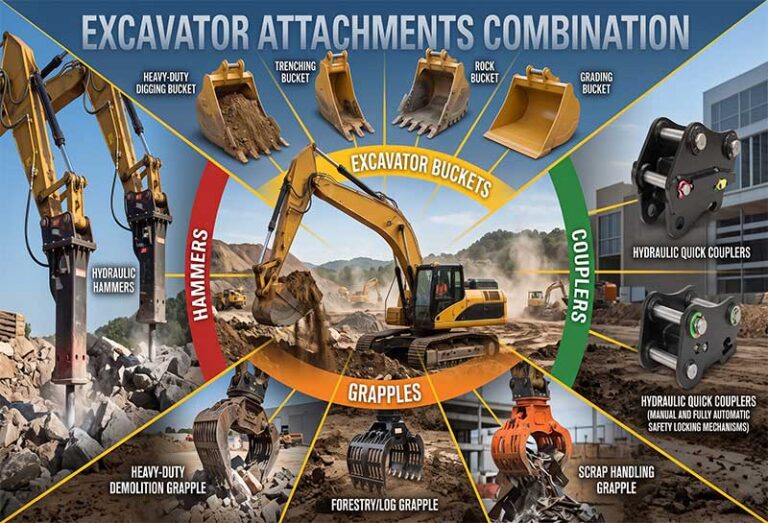
Forward‑thinking procurement teams are adopting a cost‑efficient strategy: transforming single‑function base machines into multi‑purpose workstations by deploying versatile construction equipment attachment portfolios. Instead of investing in multiple separate machines, one carrier unit can handle breaking, digging, sorting, demolition and material‑handling tasks by swapping attachments.

2. Core Market Trends Shaping 2026 Construction Equipment Attachment Industry
The global construction equipment attachment market is projected to register a 6.8% CAGR through 2030, driven by fleet optimization, urban renovation projects and rising demand for compact machinery accessories. Three transformative trends are reshaping purchasing decisions for contractors and fleet owners.
2.1 Hydraulic & Smart Attachment Upgrades Gain Traction
Demand for intelligent attachments equipped with built‑in sensors, auto‑tilt control and smart quick couplers has surged.
Over 38% of large‑volume buyers now prioritize sensor‑integrated accessories to monitor working pressure, operating hours and component wear for predictive maintenance, reducing unplanned downtime by up to 27% on job‑sites.
Operators want attachments that communicate with base machine controllers for safer, more consistent performance.
2.2 Urban Jobsites Push Low‑Noise & Eco‑Friendly Attachments
Strict municipal noise and emission regulations in dense city zones fuel market growth for low‑noise hydraulic breakers, noise‑dampened shears and grapples.
More than 41% of urban demolition and renovation tenders now include noise‑level constraints for working attachments, eliminating older high‑noise equipment from bid eligibility.
Environment‑focused attachment specifications are no longer optional for European and North American municipal projects.
2.3 Explosive Growth in Compact Equipment Attachments
Compact machines including skid‑steer loaders and mini‑excavators are dominating infill construction, backyard renovation and inner‑city retrofit projects.
Market data shows the compact equipment attachment segment grows at 9.2% year‑over‑year, outpacing heavy large‑excavator attachment growth rate. Many rental fleets expand their attachment inventory for 1‑8‑ton carriers to capture high‑margin small‑scale contract work.
Table 1: 2026 Construction Equipment Attachment Market Segment Growth Comparison
| Market Segment | Estimated YoY Growth | Key Driving Factors |
| Compact Equipment Attachments (Skid‑steer / Mini‑excavator) | 9.2% | Urban renovation, tight‑space jobsites, rental fleet expansion |
| Smart / Sensor‑Equipped Attachments | 8.1% | Predictive maintenance, safety compliance, digital fleet management |
| Heavy‑Duty Mining & Demolition Attachments | 5.7% | Infrastructure rehabilitation, quarry & mine modernization |
| Standard General‑Purpose Buckets | 4.3% | Replacement cycle of existing GET parts, routine earth‑moving |
3. Top‑Performing Attachments for B2B Buyers: Applications & ROI
Selecting the right attachments directly impacts fleet profitability. According to industry fleet surveys, properly selected attachments can boost machine utilization rates from 52% up to 83%, shortening payback periods significantly. Below table summarizes star‑category construction equipment attachments, core applications and non‑negotiable buying criteria for procurement managers.
Table 2: Top Construction Equipment Attachments, Use‑Cases & B2B Buying Focus
| Attachment Type | Core Application Scenarios | Critical B2B Buyer Focus Points |
| Hydraulic Breakers | Rock excavation, road demolition, quarry mining | Blow force output, structural durability, internal valve design for lower failure rate |
| Quick Couplers | High‑frequency attachment‑swap job‑sites | Safety locking mechanism, cross‑machine compatibility, fast switching speed |
| Grapples / Hydraulic Shears | Forestry logging, scrap recycling, building demolition | Clamping / shearing force, wear‑resistant steel grades such as Hardox |
| Specialty Buckets | Trenching, material screening, tilting & grading | Bucket tooth wear resistance, balanced dead‑weight vs volumetric capacity |
Average real‑world ROI benchmark data for these popular attachments is shown below. Most well‑manufactured attachments deliver positive returns within 6‑14 months under normal‑to‑heavy duty cycles.
Table 3: Typical ROI Benchmark for Core Construction Attachments
| Attachment Category | Average Payback Period | Key Profit‑Driving Benefit |
| Hydraulic Breaker | 10‑14 months | Eliminates manual rock breaking, cuts labour cost on demolition sites |
| Safety Quick Coupler | 6‑9 months | Cuts attachment swap time, improves operator safety, raises daily working hours |
| Grapple & Hydraulic Shear | 8‑12 months | Expands fleet service scope into recycling and demolition subcontract work |
| Specialty / Custom Buckets | 7‑11 months | Expands fleet service scope into recycling and demolition subcontract work |
4. Buyer’s Checklist: How to Avoid Common Attachment Supplier Pitfalls
Price should never be your only decision factor. Low‑cost, poorly‑manufactured attachments frequently lead to premature cracking, hydraulic leakage, host machine damage and costly project delays; industry reports note that cheap non‑standard attachments can trigger up to 20% higher unexpected repair expenses over one year of operation. When sourcing bulk orders or searching for a long‑term attachment supplier, evaluate vendors across these three core dimensions.
4.1 Material & Manufacturing Quality
Does the supplier deploy high‑strength wear‑resistant steel such as Q355, NM400 or Hardox series?
Are welding procedures certified?
Are key load‑bearing welds inspected for defects?
Are critical components like bucket teeth, pins and hydraulic parts heat‑treated for heavy‑load working scenarios?
4.2 Equipment Compatibility & Customization Capacity
Can attachments precisely match pin sizes and hydraulic parameters for mainstream brands: Caterpillar, Komatsu, Volvo, Bobcat and other OEM carriers? Poor fit will damage your base machine.
Does the attachment supplier support OEM & ODM custom‑build for special‑condition jobs (mining, Arctic cold‑climate, high‑abrasion earth‑moving)?
4.3 Supply Chain Stability & Warranty Support
What is the real‑world lead‑time for bulk orders? Can they sustain consistent delivery for repeat orders?
What warranty terms are offered for structural steel parts and core hydraulic assemblies? Clarify coverage before purchase.

5. Trusted Attachment Supplier: Truecast Engineering
With rich casting and forging manufacturing experience, Truecast Engineering stands out as a reliable attachment supplier for global B2B clients. We produce a full portfolio of construction equipment attachment and GET parts, covering hydraulic breakers, quick couplers, grapples, shears and specialty buckets. Our engineering team guarantees precise dimensional compatibility for major‑brand excavators and loaders, and supports flexible OEM / ODM custom projects. All products adopt premium wear‑resistant steel and standardized welding & heat‑treatment workflows, helping overseas buyers balance quality, lead‑time and total‑of‑ownership cost.
6. Conclusion
In 2026, construction equipment attachment will keep serving as one of the most practical capital‑optimization tools for fleet operators and contractors. Smart and compact‑machine‑oriented attachments represent the highest‑growth market segments. Successful procurement depends on balancing ROI expectations, verifying material & manufacturing quality, and partnering with a professional attachment supplier.
If you want to discuss custom attachment specifications, bulk quotation or OEM cooperation requirements, contact Truecasteng’s sales team for tailored solutions.