


How Investment Casting Improves Dimensional Accuracy in Engineering Trailers?
Engineering trailer parts operate under high dynamic loads, vibration, and repeated impact; small dimensional deviations can lead to poor assembly fit, accelerated wear, bolt loosening, or premature failure of trailer axles, hitch brackets, suspension mounts, and coupling assemblies. Investment casting, also known as lost wax casting, solves these pain points by replicating complex wax patterns into ceramic shell molds, delivering near-net-shape metal components with far superior dimensional accuracy compared to traditional sand casting for engineering trailer applications.
The global trailer equipment market continues its steady expansion, valued at USD 41.33 billion in 2025 and projected to reach USD 44.37 billion in 2026, according to industry market research data. Within this sector, buyers increasingly prioritize consistent precision over raw casting cost, because poor dimensional control raises total landed cost through rework, scrap, extra CNC machining, and field warranty claims. For heavy-duty engineering trailer OEMs and aftermarket suppliers, switching critical components to investment casting reduces cumulative tolerance stack-up during trailer assembly and improves long-term operational reliability.
Dimensional Tolerance Comparison – Investment Casting vs Sand Casting for Engineering Trailer Parts (ISO 8062 Standard)
| Manufacturing Process | ISO 8062 CT Grade | Linear Tolerance @50mm Nominal Size | Typical Surface Roughness (Ra) | Machining Allowance |
|---|---|---|---|---|
| Silica Sol Investment Casting | CT4–CT6 | ±0.18 ~ ±0.32 mm | 1.6–6.3 μm | 0.5–1.5 mm |
| Water Glass Investment Casting | CT7–CT9 | ±0.40 ~ ±0.65 mm | 6.3–12.5 μm | 1.0–2.0 mm |
| Conventional Sand Casting | CT10–CT13 | ±1.0 ~ ±3.0 mm | 12.5–50 μm | 2.0–5.0 mm |
Unlike sand casting, which uses split sand molds that introduce parting-line shift and pattern expansion errors, investment casting creates a one-piece ceramic shell around an injection-molded wax pattern. The wax melts and drains out before molten steel or alloy fills the cavity; there is no mold parting line displacement, the primary source of dimensional drift in sand cast trailer parts.
This mold design advantage is the core reason investment casting achieves tighter CT grades and predictable shrinkage compensation for complex trailer geometries, such as trailer hitch lugs, suspension brackets, and axle hangers.
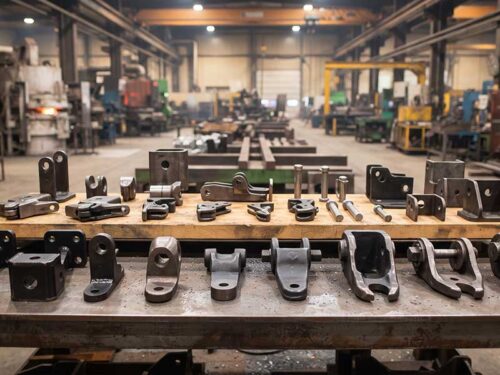
Typical Dimensional Tolerance Bands for Silica Sol Investment Cast Trailer Components
| Nominal Dimension Range (mm) | Standard CT5 Tolerance (± mm) | Precision CT4 Tolerance (± mm) | Common Trailer Part Examples |
|---|---|---|---|
| ≤ 25 | ±0.20 | ±0.15 | Pin holes, coupling inserts, small locking brackets |
| 25–80 | ±0.35 | ±0.26 | Suspension mounts, axle brackets, hitch yokes |
| 80–150 | ±0.55 | ±0.42 | Large trailer support lugs, chassis connection castings |
Wax pattern injection is the first precision control step in investment casting. Our tooling team machines aluminum injection molds to hold tight tolerances for wax patterns. We pre-calculate metal shrinkage rates for carbon steel, alloy steel and stainless steel commonly used in engineering trailer parts, so the final as-cast part lands close to nominal dimensions without excessive stock removal. Each wax pattern is inspected before shell building; rejected wax patterns are removed early to prevent dimensional defects from entering later production stages.
Ceramic shell manufacturing is another critical factor for stable dimensional accuracy in investment casting. Multi-layer silica sol ceramic shells cure at controlled temperature and humidity, minimizing shell warpage during dewaxing and high-temperature pouring. In sand casting, mold compaction variation causes inconsistent part shrinkage from batch to batch. Investment casting’s rigid ceramic shell restricts uneven expansion and contraction, delivering low batch-to-batch weight variation of ±1–2%, compared to ±5–10% for sand castings. This consistency is extremely valuable for high-volume engineering trailer OEM orders, where thousands of parts must interchange smoothly on assembly lines.
Cost & Performance Impact of Dimensional Accuracy for Trailer Castings
| Evaluation Item | Investment Casting | Sand Casting | Business Impact for Trailer OEM |
|---|---|---|---|
| As-cast scrap rate | 1.2–2.8% | 4.5–9.0% | Lower scrap reduces raw material waste |
| Required secondary machining operations | 1–2 critical features | 3–5 features | Less CNC time cuts total part cost |
| Assembly rework rate | <1.5% | 5–8% | Fewer fit issues on trailer production lines |
| Batch interchangeability | Excellent | Moderate | Simplified inventory and aftermarket replacement |
Even though investment casting per-kilogram raw casting price is higher than sand casting, the total cost of ownership is often lower for high-precision trailer components. Reduced machining stock cuts CNC cycle time, fewer rejected parts lower scrap loss, and consistent dimensional accuracy eliminates costly assembly rework.
Many of Truecast Engineering’s engineering trailer customers report that investment cast hitch and suspension parts reduce trailer field maintenance complaints because mating surfaces maintain correct alignment under heavy hauling loads.
Which Engineering Trailer Components Benefit Most from Investment Casting Dimensional Control?
Not all trailer parts require investment casting, but safety-critical mating components are ideal candidates:
- – Trailer hitch brackets and coupling lugs
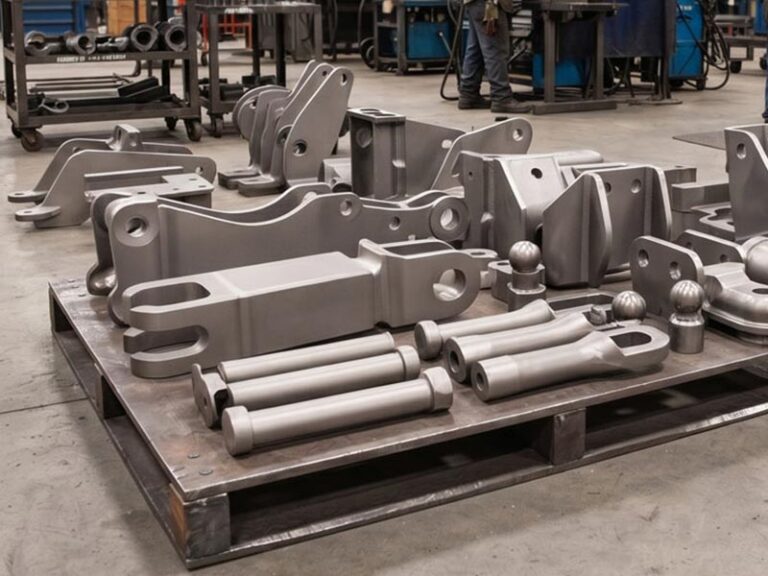
- – Axle hangers and suspension connection castings
- – Locking pins, latch bodies and safety catch assemblies
- – Chassis reinforcement castings and load-bearing mounts
These parts require precise hole positioning, flat mating faces, and consistent wall thickness. Dimensional drift can cause binding, uneven load distribution, and accelerated fatigue failure. Investment casting locks in these critical as-cast dimensions and reduces reliance on post-cast machining. For features requiring ultra-tight tolerances beyond CT4, Truecast Engineering combines investment casting blanks with in-house CNC machining to hit final drawing specifications.
Conclusion
Investment casting improves dimensional accuracy in engineering trailer components by eliminating split-mold shifting, using pre-compensated wax patterns, rigid ceramic shells, and controlled solidification. The process delivers CT4–CT6 tolerance grades, smooth surface finish, low batch variation and reduced machining requirements for safety-critical trailer castings. While sand casting remains suitable for simple, low-tolerance trailer structural parts, investment casting is the preferred solution for OEMs aiming to reduce assembly rework, lower long-term failure risk and stabilize part interchangeability in heavy-duty engineering trailers.
If you need custom investment casting for your engineering trailer project, send your CAD drawings and tolerance requirements to our engineering team for a free DFM review and quotation.