


How to Choose the Right Trailer Suspension to Maximize Fleet Profitability
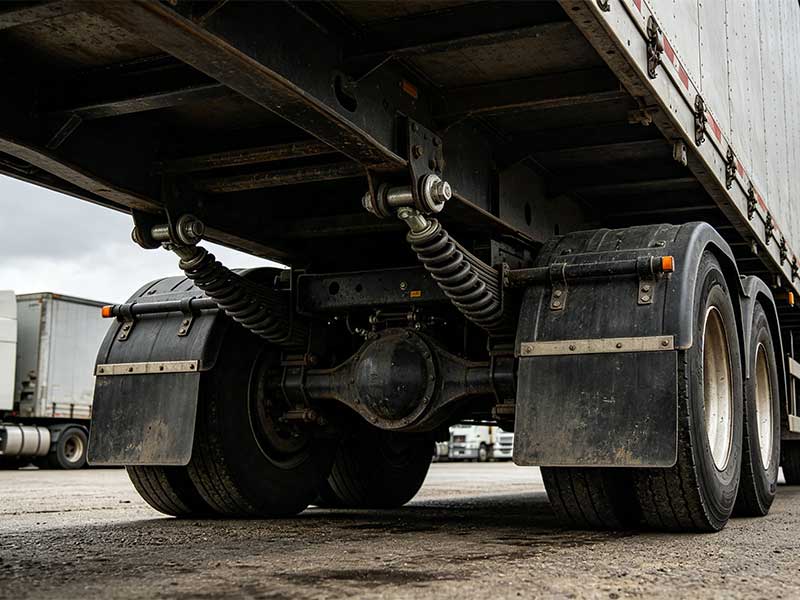
A high-performance trailer suspension system is far more than a mechanical connection between trailer axles and chassis. As the core component that governs cargo stability, tire wear efficiency, and fleet uptime, a properly selected trailer suspension system directly determines 30% of a fleet’s annual maintenance costs and 40% of tire service life, according to 2026 commercial vehicle industry data from the Commercial Vehicle Safety Alliance (CVSA).
Poorly matched or low-quality trailer suspension systems are the leading cause of unplanned fleet downtime. Industry statistics show that suspension-related faults account for 28% of all trailer maintenance incidents annually, with unplanned downtime costing mid-to-large fleets an average of $800–$1,200 per vehicle per day.
While low-cost generic suspensions reduce upfront procurement expenses, they trigger repetitive repairs, frequent tire replacements, and cargo damage risks that erode profit margins year-round.
1. Matching Application and Load: Select the Right Trailer Suspension System
The first step to reliable trailer suspension procurement is matching the suspension type to your actual operating conditions and load requirements.
Mechanical leaf spring and air ride suspensions are the two mainstream trailer suspension system types on the market, with distinct structural advantages, load limits, and applicable scenarios. Choosing blindly will lead to performance redundancy or insufficient load capacity. Below is a detailed comparison of the two core suspension solutions and key parameter evaluation standards.
1.1 Mechanical/Leaf Spring Suspensions
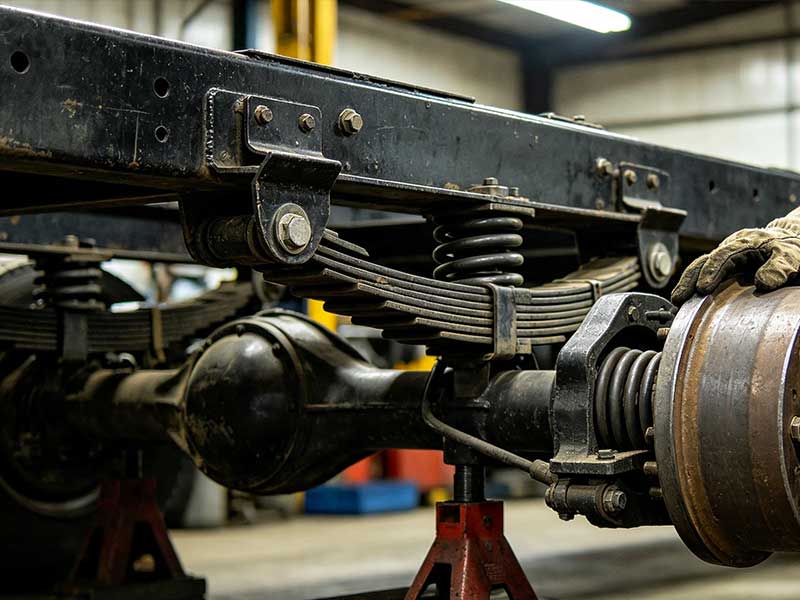
Mechanical leaf spring suspensions are the most traditional and widely used trailer suspension solution, featuring an ultra-simple structural design with fewer vulnerable parts. Built with thickened leaf springs and integrated load-bearing brackets, this suspension delivers exceptional overload resistance and structural stability under extreme pressure. Its streamlined assembly greatly reduces initial procurement costs, making it a cost-effective choice for heavy-duty and harsh-condition transportation fleets.
Per industry engineering data, mechanical suspensions can sustain 15–20% short-term overload without structural deformation, outperforming air ride suspensions in impact resistance. Ideal application scenarios include heavy-duty bulk cargo transportation, mining operations, construction site haulage, and frequent driving on unpaved, bumpy, or gravel roads. It is also the preferred option for low-frequency, high-load short-distance transportation with strict upfront budget controls.
1.2 Air Ride Suspensions
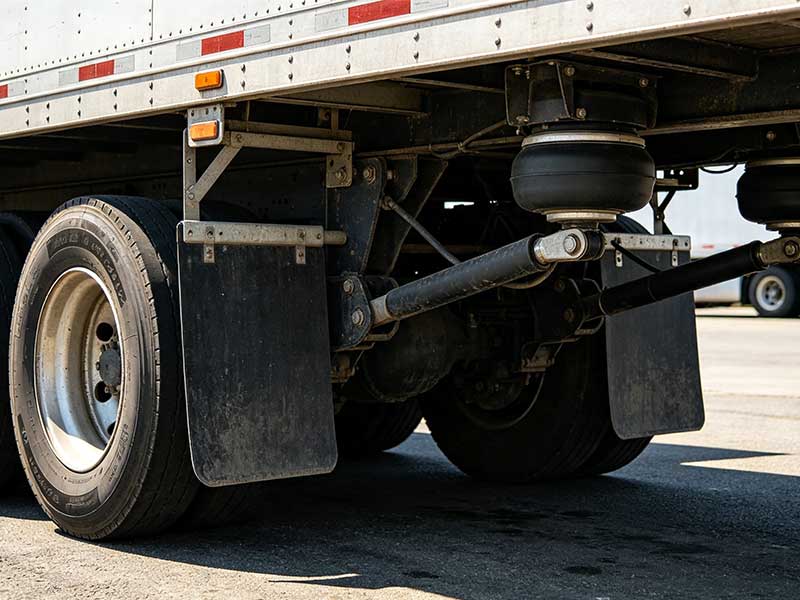
Air ride suspension systems adopt airbags as the core load-bearing component, replacing traditional leaf springs to achieve adjustable damping and flexible height control. This design delivers superior shock absorption performance, reducing road vibration transmission to the trailer chassis by up to 65% compared with mechanical suspensions, per 2026 CVSA road test data. It effectively protects high-value, fragile, and precision cargo from vibration damage during long-haul transportation.
In addition to cargo protection, air ride suspensions feature a lightweight structure, reducing trailer dead weight by 80–150kg. This lightweight advantage increases legal payload capacity, directly boosting single-trip revenue for fleets. It is highly suitable for long-distance highway logistics, cold chain transportation, electronic precision cargo delivery, and compliant fleets pursuing lightweight optimization and high cargo safety standards.
1.3 Key Specification Parameters for Suspension Matching
Beyond suspension type selection, targeted parameter verification is essential to avoid mismatch and performance waste. Two core parameters determine the compatibility and practical performance of the trailer suspension system: axle load capacity and ride height matching.
Axle load capacity: Mainstream commercial trailer suspensions cover 9T to 16T axle load specifications. Overloading beyond the rated capacity will accelerate spring fatigue, bracket cracking, and axle deformation, while excessive rated load will cause unnecessary cost waste.
Ride height compatibility: The suspension’s installed ride height must match the trailer chassis and axle brand specifications to ensure consistent tire grounding pressure and stable driving posture, avoiding unilateral tire wear and driving deviation.
|
Core Comparison Item
|
Mechanical Leaf Spring Suspension
|
Air Ride Suspension
|
|---|---|---|
|
Core Advantages
|
Simple structure, strong overload resistance, low initial cost, few vulnerable parts
|
Excellent shock absorption, cargo protection, lightweight design, adjustable ride height
|
|
Best Application Scenarios
|
Mining, construction sites, unpaved roads, heavy short-haul bulk transport
|
Long-haul highway, cold chain, high-value fragile cargo, lightweight compliant fleets
|
|
Axle Load Range
|
10T–16T (heavy-load focused)
|
9T–13T (medium-load precision transport)
|
|
Average Tire Wear Rate
|
Moderate (stable for harsh road conditions)
|
30% lower than mechanical suspension (smooth highway driving)
|
2. Manufacturing Quality & Durability: Core Craft That Determines Suspension Lifespan
Service life and operational stability are the core indicators B2B buyers prioritize when selecting a trailer suspension system. Many low-cost suspensions fail early not due to design flaws, but inferior materials and rough manufacturing processes.
Premium trailer suspension supplier relies on high-standard material selection and precision craftsmanship to extend suspension service life by 40–50% compared with industry average products, reducing long-term replacement frequency.
2.1 High-Strength Material Selection & Key Component Forming
The load-bearing performance and fatigue resistance of a trailer suspension depend entirely on raw material quality. Top-tier suspensions adopt high-strength low-alloy structural steel for main beams and load-bearing components, with a tensile strength of over 980MPa, far exceeding ordinary carbon steel. This material maintains structural stability under long-term alternating load and extreme temperature changes, avoiding permanent deformation and fatigue cracking.
For core connecting parts such as suspension brackets and spring seats, professional suppliers adopt precision die-casting and CNC machining technology instead of ordinary welding forming. Integrated die-casting eliminates welding gap defects, while high-precision machining ensures component fitting accuracy within 0.02mm, effectively improving overall structural rigidity and anti-fatigue performance for long-term high-frequency operation.
2.2 Robotic Welding & Anti-Corrosion Technology
Welding quality is the key to suspension structural integrity. Traditional manual welding suffers from inconsistent weld width, uneven penetration, and hidden cracks, which become failure points under long-term vibration. Qualified trailer suspension supplier adopts fully automatic robotic welding production lines, realizing uniform weld penetration, seamless splicing, and 100% non-destructive welding quality inspection. Industry data shows that robotic welding improves suspension structural stability by 35% and reduces welding failure rates to below 0.5%.
Road salt, rainwater, mud, and humid air will cause electrochemical corrosion on suspension metal parts, leading to rust, component thinning, and performance degradation. Premium suspensions adopt dual anti-corrosion technology: electrophoretic primer (E-coating) penetrates every tiny gap to form a uniform anti-rust layer, while outdoor powder coating enhances surface wear and corrosion resistance. This dual-process treatment extends the suspension’s anti-corrosion lifespan to more than 8 years, avoiding early rust and paint peeling common in low-end products.
3. TCO Calculation: Cut Long-Term Costs & Maximize Fleet Profitability
Suspension procurement cannot only focus on upfront purchase price. The total cost of ownership (TCO) covering lightweight income, tire wear savings, and maintenance costs determines the actual profitability of the trailer suspension system. Industry financial analysis shows that high-quality matched suspensions can reduce fleet annual comprehensive operating costs by 12–18%.
3.1 Lightweight Design Boosts Effective Payload & Revenue
Lightweight optimization is a core profit growth point for modern compliant fleets. Every 100kg reduction in trailer suspension dead weight increases legal payload by 100kg per trip. Calculated by the average long-haul logistics freight standard of $0.8 per kg per 100km, a lightweight suspension can generate an additional $300–$500 monthly revenue per trailer for fleets with frequent long-distance operations. Within one year, the increased freight revenue can offset the premium of high-quality lightweight suspension procurement.
3.2 Precision Alignment Reduces Abnormal Tire Wear
Tire replacement is one of the largest daily maintenance expenditures for fleets. CVSA industry data confirms that 42% of premature trailer tire wear is caused by inaccurate suspension alignment and unparallel axle spacing. High-precision manufactured trailer suspension system ensures strict parallelism between axles and consistent tire grounding pressure, eliminating unilateral wear, eccentric wear, and tire overheating failure.
Fleet operation feedback shows that standardized high-precision suspensions extend tire service life from 80,000km to 120,000km on average, reducing annual tire replacement frequency by 30–40% and saving thousands of dollars in single-vehicle tire costs every year.
3.3 Low-Maintenance Design & Universal Standardized Parts
Unplanned maintenance downtime and hard-to-source replacement parts are hidden profit killers for fleets. Premium suspensions adopt maintenance-free bushing designs for core moving parts, eliminating regular lubrication and replacement maintenance, saving labor costs and vehicle offline time.
Meanwhile, formal trailer suspension supplier fully standardizes core accessories such as U-bolts, fasteners, and connecting pins, which are universally compatible with mainstream market models.
Standardized accessories enable fleet maintenance teams to quickly purchase replacement parts locally, shortening fault repair time from 2–3 days to within 4 hours, greatly improving fleet attendance and operational efficiency.
|
TCO Optimization Dimension
|
Annual Cost Savings & Profit Improvement Data
|
Optimization Principle
|
|---|---|---|
|
Lightweight Payload Increase
|
$3,600–$6,000 extra annual revenue per trailer
|
Reduce dead weight, increase legal single-trip freight volume
|
|
Tire Wear Reduction
|
35% lower annual tire replacement cost
|
Precision axle alignment avoids abnormal tire wear
|
|
Maintenance & Downtime Saving
|
40% reduction in annual maintenance labor & part costs
|
Maintenance-free design + universal standardized parts
|
4. Trailer Suspension Supplier Evaluation: Key Factors Beyond Product Quality
Product performance is the foundation, but supplier comprehensive strength determines long-term stable cooperation and after-sales guarantee. When screening a reliabletrailer suspension supplier, B2B buyers need to comprehensively verify qualification certification, production capacity, customization capability, and after-sales service system to avoid supply chain risks and service gaps.
4.1 Industry Certification & Compliance Qualifications
Formal international quality system certification is the most intuitive standard to measure product stability. Reliable trailer suspension supplier must hold ISO 9001 quality management system certification and IATF 16949 automotive industry quality certification, the authoritative industry standards for commercial vehicle parts manufacturing. These certifications ensure that every production link from raw material incoming inspection to finished product delivery implements standardized quality control, avoiding unqualified products and performance instability.
4.2 Production Capacity, Delivery Stability & Customization Service
For bulk procurement fleets and trailer manufacturers, stable delivery capacity is crucial to avoid production and operation delays. Professional suspension manufacturers own standardized automated production workshops, with stable mass production capacity to meet large-scale order demands and ensure on-time delivery rate above 98%.
In addition, mature suppliers support OEM/ODM customized services, which can adjust suspension parameters, structural dimensions, and surface processes according to customers’ special trailer chassis design and personalized operating condition needs, solving customized matching problems for special vehicles.
4.3 Transparent Warranty & Responsive After-Sales Support
Perfect after-sales service is the final guarantee of suspension operational stability. Excellent trailer suspension supplier provides transparent and standardized warranty clauses, with a clear warranty period for core load-bearing components.
Meanwhile, it has a professional technical support team to respond to customer fault consultation and solution demands quickly, providing remote technical guidance and on-site after-sales service support to minimize fleet downtime losses caused by suspension faults.
5. Conclusion
A high-quality, well-matched trailer suspension system is a core investment for fleets to reduce TCO, improve operational stability, and maximize long-term profits, rather than a simple consumable expense.
From reasonable selection of mechanical or air ride suspensions based on working conditions, to verification of manufacturing processes and material quality, and scientific evaluation of trailer suspension supplier strength, every link directly affects fleet operational efficiency and profit margins.Avoid blind low-price procurement and one-sided parameter pursuit; scientific matching and high-quality supply chain cooperation are the keys to sustainable fleet operation.
If you are looking for a reliable trailer suspension supplier for your new trailer project or fleet renewal, contact our professional engineering team today. Truecasteng provides free customized suspension solution evaluation, professional parameter matching consultation, and exclusive OEM/ODM quotation services to help you optimize fleet TCO and maximize operational profitability.