


Mounted vs Pull-Type Disc Harrow: How to Select the Right Disc Harrow
Mounted vs pull-type disc harrow is one of the most common purchasing decisions for farm managers, contractors and agricultural equipment dealers sourcing disc harrow implements for secondary tillage, stubble breaking and seedbed preparation.
At Truecast Engineering, a professional manufacturer and supplier of agricultural machinery and replacement GET parts, we work closely with B2B buyers across North America, Europe and Australia to match disc harrow models to field size, tractor capacity and soil conditions. This side-by-side guide breaks down performance, specifications and market trends to simplify your disc harrow procurement.
1. Global Disc Harrow Market Overview
The global disc harrow market continues steady expansion, projected at a CAGR of 5.3% from 2024 to 2030, as more medium and large farms upgrade tillage equipment to boost field throughput and soil preparation quality (Grand View Research, 2024). Pull-type (trailed) disc harrows hold the larger market share at 49.09%, valued at USD 908.13 million, while mounted disc harrows capture 41.11% market share at USD 760.59 million in 2025. This split reflects real-world preference: pull-type disc harrows dominate large-acreage commercial farming, while mounted disc harrows remain the top pick for small and mid-sized farms with compact tractors.
Table 1: Disc Harrow Market Share & Value by Type (2025)
| Disc Harrow Type | Market Value (USD Million) | Market Share | Primary Buyer Profile |
|---|---|---|---|
| Pull-Type Disc Harrow | 908.13 | 49.09% | Large farms, custom tillage contractors, wide-field operations |
| Mounted Disc Harrow | 760.59 | 41.11% | Mid/small farms, compact tractor fleets, narrow fields |
| Offset Disc Harrow | 181.28 | 9.80% | Specialty crops, hilly terrain, edge-of-field tillage |
2. Mounted Disc Harrow: Working Principle & Key Benefits
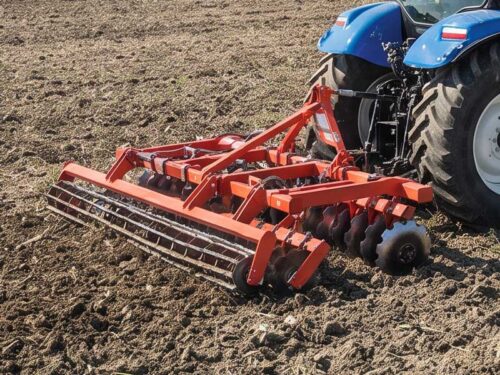
A mounted disc harrow connects directly to your tractor’s three-point hitch. The tractor’s rear hydraulic lift fully supports the implement during transport and headland turns. Most mounted disc harrow units are compact, rigid-frame designs with fixed working widths, ideal for secondary tillage, breaking light clods and preparing seedbeds in smaller fields.
Core advantages of mounted disc harrow
- – Simple hitching and fast transition between transport and working mode
- – Tighter turning radius, better maneuverability for small, irregular fields
- – Lower upfront investment compared to heavy pull-type disc harrow
- – Easy storage; no separate parking stands required
- – Weight transfers partially to tractor rear axle, improving traction on light soils
Limitations of mounted disc harrow
- – Restricted by tractor lift capacity; cannot carry extremely heavy frames or large disc gangs
- – Less ground-following performance on rolling, undulating terrain
- – Narrower maximum working width, lower hourly field coverage for big farms
- – Higher risk of rear-end tipping if overloaded beyond hitch rating
3. Pull-Type Disc Harrow: Working Principle & Key Benefits
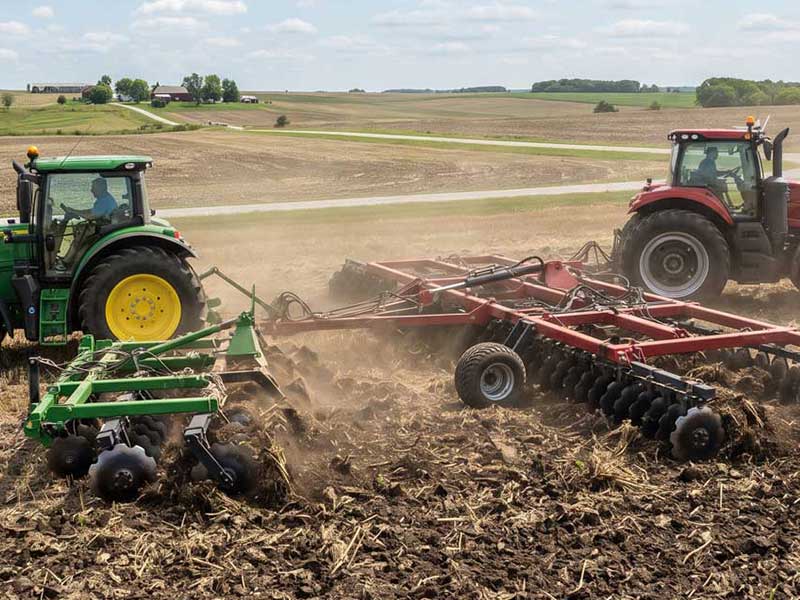
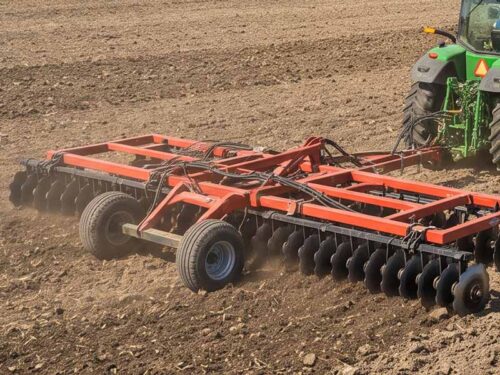
Pull-type disc harrow, also called trailed disc harrow, attaches to the tractor drawbar with its own wheels and independent frame. The full implement weight rests on the disc gangs, delivering deeper, more consistent soil penetration for heavy residue, hard compacted ground and large-scale tillage. Hydraulic folding pull-type disc harrow models can reach very wide working widths while shrinking transport width for road movement.
Core advantages of pull-type disc harrow
- – Full machine weight acts on discs for superior penetration in hard soil or heavy crop stubble
- – Better terrain following on uneven and rolling land
- – Wider working widths for high-acreage operations, higher hectares per hour
- – Lower stress on tractor three-point hitch; only draft load transfers to tractor
- – Scalable heavy-duty frames compatible with large high-horsepower tractors
Limitations of pull-type disc harrow
- – Requires larger turning space at field headlands
- – Higher purchase cost and larger storage footprint
- – Extra maintenance on transport wheels, bearings and hydraulic folding cylinders
- – Longer hitching time between jobs
Table 2: Mounted vs Pull-Type Disc Harrow Technical Spec Comparison
| Parameter | Mounted Disc Harrow | Pull-Type Disc Harrow |
|---|---|---|
| Connection | 3-point hitch | Drawbar / tow hitch |
| Recommended HP Range | 35–100 HP | 75–180+ HP |
| Typical Working Width | 1.8–4.0 m | 2.4–6.0 m (hydraulic folding up to 8m) |
| Working Depth | 8–14 cm | 10–20 cm |
| Machine Weight Support | Tractor hydraulic lift | Self-contained transport wheels |
| Best Field Size | Small to medium fields (<80 ha) | Medium to large commercial fields (>80 ha) |
| Turning Requirement | Minimal headroom | Larger turning radius |
| Typical Operating Speed | 6–8 km/h | 8–12 km/h |
4. Operational Cost & Throughput Comparison
For B2B buyers evaluating long-term ROI, hourly coverage and fuel consumption are critical when choosing between mounted disc harrow and pull-type disc harrow. Pull-type disc harrow delivers much higher throughput, but demands higher horsepower and slightly more fuel consumption per hectare in heavy soil. Mounted disc harrow uses less tractor power and suits intermittent, small-batch tillage work.
Table 3: Field Performance & Operational Economics
| Metric | Mounted Disc Harrow | Pull-Type Disc Harrow |
|---|---|---|
| Hectares per Hour | 1.0–2.5 ha/h | 2.8–5.5 ha/h |
| Fuel Consumption (L/ha) | 4–7 L | 6–10 L |
| Typical Service Interval | 120–180 working hours | 100–150 working hours |
| Primary Wear Parts | Disc blades, bearings, scraper | Disc blades, wheel bearings, hydraulic hoses |
| Relative Upfront Cost Index | 1.0 (baseline) | 1.7–2.4 |
5. How to Choose Between Mounted Disc Harrow and Pull-Type Disc Harrow
Use these practical selection rules to match your disc harrow to your operation:
- 1. Tractor horsepower & hitch capacity: If your fleet runs compact tractors below 70 HP, a mounted disc harrow is usually the safe choice. For tractors above 100 HP and large acreage, pull-type disc harrow will deliver better tillage quality and productivity.
- 2. Field shape and terrain: Narrow, small, or hilly fields favour mounted disc harrow. Wide, flat commercial fields with heavy stubble are best suited for pull-type disc harrow.
- 3. Workload type: Mounted disc harrow excels for light secondary tillage and seedbed finishing. Pull-type disc harrow handles primary breaking, heavy residue management and deep soil loosening.
- 4. Transport & storage constraints: Limited yard storage or frequent road travel between small fields makes mounted disc harrow easier to manage. Pull-type disc harrow needs dedicated parking space and transport permits for over-width models.
- 5. Spare parts availability: Both disc harrow types share common wearing parts such as disc blades, scrapers and bearings. As a disc harrow parts supplier, Truecasteng stocks hardened boron steel disc blades and replacement components for both mounted and pull-type disc harrow.
6. Common Disc Harrow Maintenance Tips
No matter whether you operate mounted disc harrow or pull-type disc harrow, regular maintenance extends service life and avoids costly downtime:
- – Inspect disc blades daily for cracks, bending and dull cutting edges; replace worn disc blades before penetration drops
- – Grease bearings after every field day
- – Adjust disc gang angle and scraper clearance to prevent soil buildup
- – Check frame bolts and drawbar connections before heavy tillage work
- – Store disc harrow under cover to reduce rust on steel frame and disc components
7. Final Recommendations for B2B Buyers
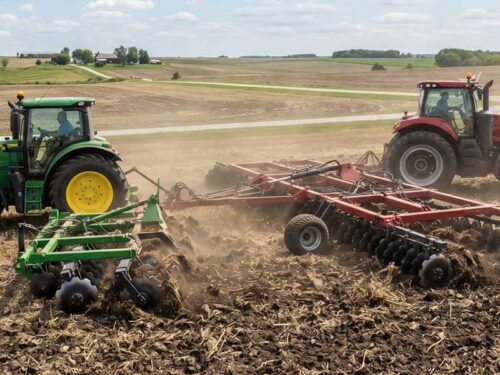
For resellers, farm contractors and farm owners, there is no universal “better” disc harrow, only the correct disc harrow for your tractor, acreage and soil type. Mounted disc harrow offers low entry cost, great agility and simple operation for small to medium farms. Pull-type disc harrow provides heavy-duty tillage capacity and high throughput for commercial-scale farming.
At Truecast Engineering, we manufacture complete disc harrow implements and supply OEM replacement disc harrow spare parts, including disc blades, scrapers, bearings and frame assemblies. Contact our engineering team to discuss custom disc harrow specifications, bulk pricing and OEM manufacturing for your market.
FAQ
Q1: Can I use a pull-type disc harrow on a 60 HP tractor?
A: A small light-duty pull-type disc harrow may work, but draft load will be high. We recommend mounted disc harrow for tractors under 70 HP for safer operation.
Q2: Are disc blades interchangeable between mounted disc harrow and pull-type disc harrow?
A: Many standard diameter disc blades are interchangeable if hub size matches. Heavy-duty pull-type disc harrow often uses thicker boron steel disc blades for higher impact loads.
Q3: What is the difference between trailed disc harrow and pull-type disc harrow?
A: Pull-type disc harrow and trailed disc harrow refer to the same category: drawbar-towed disc harrow, the opposite of 3-point mounted disc harrow.