


Machining Tolerances for Trailer Hubs: Concentricity & Cylindricity Standards for Bearing Seats
Machining tolerances for trailer hubs define the geometric limits of bearing seats, directly controlling bearing service life, wheel-end heat generation, seal integrity and highway safety for light, medium and heavy-duty trailer axles.
The aftermarket trailer component market continues to place higher emphasis on precision machining, as industry data shows misaligned bearing seats account for roughly 32% of premature trailer wheel bearing failures in field service reports, ahead of lubrication contamination and overload damage.
Grand View Research’s commercial vehicle aftermarket forecast also notes that buyers increasingly prioritize verified tolerance reports and first-pass inspection data instead of only raw material certification, especially for heavy agricultural trailers and semi-trailer running gear where downtime costs run high. While many foundries can cast trailer hub blanks, only shops with stable fixturing and closed-loop inspection can consistently hold tight concentricity and cylindricity across batch production.
Core Geometric Requirements for Trailer Hub Bearing Positions
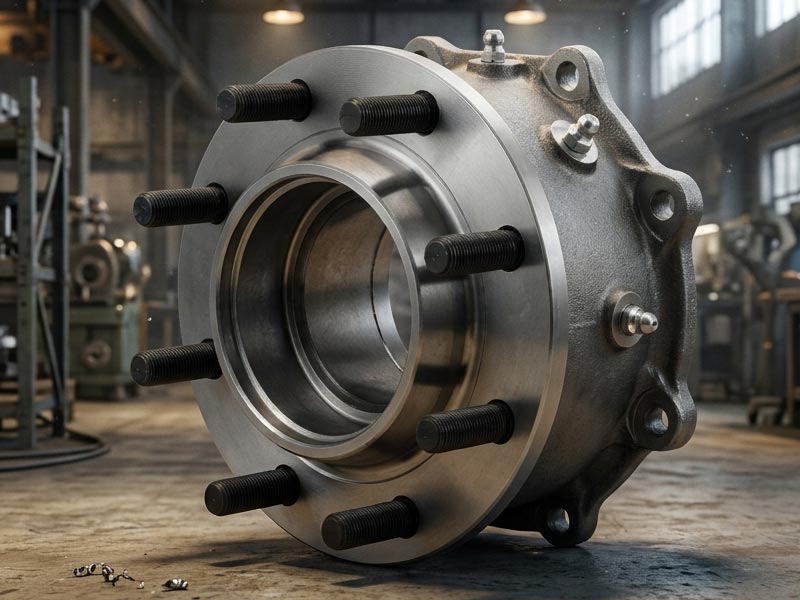
Two geometric tolerances dominate bearing seat performance: concentricity (radial alignment between inner and outer bearing seats relative to the hub datum axis) and cylindricity (the combined form control for roundness, straightness and taper across the full bearing contact length). Many buyers mistakenly use simple diameter tolerance alone; a bore that meets H7 size limits can still fail in service if taper or runout loads the tapered roller bearing unevenly.
Table 1: Recommended Concentricity Tolerance for Trailer Hub Dual Bearing Seats (ISO 1101)
| Trailer Load Class | Bearing Seat Concentricity TIR (mm) | Bearing Seat Concentricity TIR (inch) | Typical Application |
|---|---|---|---|
| Light-duty ≤3.5 ton | ≤0.04 | 0.0016 | Utility, small farm trailer |
| Medium-duty 3.5–12 ton | ≤0.03 | 0.0012 | Livestock, flatbed trailer |
| Heavy-duty ≥12 ton / Semi-trailer | ≤0.02 | 0.0008 | Lowboy, grain, container trailer |
Concentricity deviation forces one bearing cup to carry disproportionate radial load. Over time, this creates hot spots, grease degradation and seal lip wear, leading to wheel-end leaks and roadside failures. Our standard production spec for heavy-duty trailer suspension castings locks concentricity at 0.02 mm TIR for dual tapered roller bearing seats, verified on every first article and periodic production sample.
Table 2: Cylindricity Tolerance for Trailer Hub Bearing Housing Bores
| Bearing Precision Grade | Bore Diameter Range (mm) | Cylindricity Max (µm) | Surface Roughness Ra (µm) |
|---|---|---|---|
| P0 (Standard Trailer) | 40–80 | 8 | ≤1.6 |
| P6 (Premium / High-speed highway) | 80–130 | 5 | ≤0.8 |
| P5 (Special low-vibration OEM) | 130–200 | 3 | ≤0.4 |
Cylindricity combines roundness, bore taper and generatrix straightness. A tapered bore causes the bearing raceway to tilt during press-fit assembly, reducing effective contact area. For ductile iron trailer hubs, we apply finish turning with rigid tailstock support and low-feed finishing passes to avoid tool deflection that introduces taper error. Surface roughness is paired with cylindricity because rough peaks accelerate micro-wear between the cast hub housing and outer bearing cup, even when geometry is within tolerance.
Table 3: Inspection Method Comparison for Bearing Seat Geometry
| Inspection Method | Measurable Parameters | Typical Repeatability | Best Use Case |
|---|---|---|---|
| Dial Indicator / DTI on CNC fixture | Concentricity, total radial runout | ±0.003 mm | In-line batch sampling, fast screening |
| Coordinate Measuring Machine (CMM) | Concentricity, cylindricity, roundness, taper | ±0.0015 mm | First article, PPAP, disputed parts, audit samples |
| Bore Gauge + Roundness Tester | Cylindricity and local diameter variation | ±0.002 mm | High-volume serial production quality gate |
Each inspection workflow has tradeoffs. Dial indicator runout is fast and economical for production checks, but it cannot separate cylindricity error from pure eccentricity. CMM delivers full GPS-compliant geometric reports that OEM customers require for PPAP submission, though cycle time is longer. At TrueCast Engineering, we combine both workflows: dial indicator for every machined hub at the station, with scheduled CMM validation to confirm the process capability (Cp/Cpk >1.33) for critical trailer hub tolerances.

Why Tolerance Stack-Up Matters for Trailer Hub Assembly
Trailer hub machining does not exist in isolation. Tolerance stack-up includes casting shrinkage allowance, turning fixture offset, spindle runout, bearing dimensional spread and axle spindle tolerance. If the hub bearing seat concentricity drifts to 0.05 mm or higher, the assembly loses its designed preload window for tapered roller bearings. Operators may over-torque axle nuts to compensate, which shortens bearing life dramatically.
Our process sequence for trailer hubs is engineered to reduce stack-up: ductile iron casting → stress relief annealing → rough machining → secondary stress relief → finish turning of both bearing seats in a single chucking setup. Single-setup machining eliminates re-clamping error, which is the top source of concentricity drift in many generic foundry-machined hubs. This process is especially important for trailer suspension castings and axle components exposed to cyclic vibration on gravel roads and long-distance highway routes.
Step-by-Step Inspection Workflow for Bearing Seat Concentricity & Cylindricity
- 1. Clean and datum setup: Remove burrs, coolant residue and casting scale. Establish the hub flange face and central axis as primary datum per the customer drawing or ISO 1101.
- 2. Dial indicator concentricity check: Secure the hub on a precision mandrel matched to the spindle bore. Set the indicator tip on the bearing seat OD/ID, rotate the hub 360°, record total indicator reading. Compare reading against Table 1 limits.
- 3. Cylindricity sampling: For formal validation, capture multiple axial sections along the bearing seat length with CMM or roundness equipment, evaluating roundness at top, mid and bottom of the bearing engagement zone.
- 4. Cross-check seal surface runout: The oil seal seating face often shares the same machining pass; excessive runout here will cause seal twisting and premature grease leakage, even if bearing seats are good.
- 5. Document the report: Attach raw readings, CMM point cloud data and material certificate for traceability. B2B trailer buyers require this documentation for batch acceptance.
Common field misconception: a small amount of runout can be absorbed by bearing clearance. Tapered roller bearings used in most heavy trailer wheel ends are not designed to compensate for hub geometric errors; they compensate only for minor thermal expansion and controlled preload. Persistent misalignment creates edge loading, spalling and heat discoloration on bearing rollers and cups.
Practical Tolerance Guidance for OEM Drawing Release
When drafting trailer hub drawings, engineers should separate size tolerance (H7 housing bore is typical for standard P0 bearings) from geometric tolerances. Do not apply concentricity loosely; always define the datum clearly on the wheel flange or pilot diameter. Avoid over-specifying P5 grade for general highway trailers, as it raises machining cost without measurable field benefit, while skipping cylindricity control to save cost creates hidden warranty risk.
For custom trailer hubs, TrueCast Engineering accepts customer tolerance packages and can adjust our CNC fixturing and inspection frequency to match your axle design requirements. We regularly machine trailer hubs paired with our trailer suspension castings, ensuring mating geometry between hub, spindle and suspension parts remains consistent across production runs.
Frequently Asked Questions
Q1: What is the difference between concentricity and radial runout for a trailer hub bearing seat?
A: Concentricity evaluates the median axis of the bearing seat relative to the datum axis. Total radial runout combines axis offset plus form errors such as ovality. Many trailer axle drawings specify TIR runout as a practical production proxy, while concentricity is used for formal GPS engineering validation.
Q2: Can I rework a trailer hub that fails cylindricity inspection?
A: Minor taper errors may be re-finished only if there is sufficient stock and the surface meets roughness requirements. Severe ovality or deep chatter marks from unstable turning cannot be reliably reworked, and we recommend scrapping the part rather than risking wheel-end failure.
Q3: Does ductile iron material affect achievable machining tolerances?
A: Ductile iron offers excellent vibration damping and machinability, but inconsistent casting hardness and residual stress will shift geometry after machining. Stress relief heat treatment before finish machining is mandatory to hold stable concentricity and cylindricity in trailer hub mass production.