


Motor Grader Cutting Edges & End Bits: Maintenance & Material Selection Guide
1. Grader Cutting Edges & End‑Bits: Maintenance & Material Specification for Abrasive & Impact‑Heavy Applications
Motor grader performance heavily depends on Ground‑Engaging Tools (GET). The central cutting blade and end‑bits directly define grading accuracy, operating efficiency and overall machine structural service life.
Industry aftermarket statistics show that 41 % of motor grader unplanned downtime originates from GET‑related failures, including blade breakage, bolt hole elongation and moldboard substrate wear. For fleet managers, OEM replacement buyers and custom‑casting procurement teams, combining structured maintenance workflows and correct material‑heat‑treatment selection delivers substantial total‑cost‑of‑ownership savings.
Table 1: Motor Grader GET Inspection & Maintenance Schedule
| Inspection Item | Inspection Criteria | Recommended Service Frequency |
|---|---|---|
| Cutting edges & end‑bits | Measure residual wear thickness; inspect cracking, spalling and chipping damage | Daily / Every shift |
| Plow bolts & fasteners | Check loose, missing or stretched bolt holes; retorque as specification | Weekly; re‑torque 10‑15 working hours after new part installation |
| Circle & slide rail assembly | Remove sediment, apply grease, detect abnormal clearance | Every 50 working hours |
| Hinge pins & lock plates | Check pin wear, lock‑tab deformation | Every 100 working hours |
| Moldboard & support structures | Visual check for substrate deformation, weld‑zone fatigue cracks | Every 250 working hours / Monthly |
Critical maintenance note:
Never allow cutting edges to wear down until the bare moldboard substrate contacts ground surface. Replace or reverse reversible bolt‑on cutting edges when wear approaches 25 mm from bolt holes.
End‑bits sustain far higher alternating stress and abrasion, requiring more‑frequent replacement than middle‑section cutting edges.
All fasteners shall be grade 8.8 or 10.9 high‑strength plow bolts. Heavy operating vibration will loosen connections; missed re‑torque is the leading cause of oval‑shaped bolt holes and premature part loss.
Regular lubrication for grader circle gear and slide rails eliminates dry friction and protects precision machined surfaces. Periodic visual inspection on cast and welded support brackets identifies metal‑fatigue micro‑cracks concentrated at stress hot‑spots before catastrophic failure occurs.
2. Material & Heat‑Treatment Comparison: High‑Carbon Steel vs Boron Steel
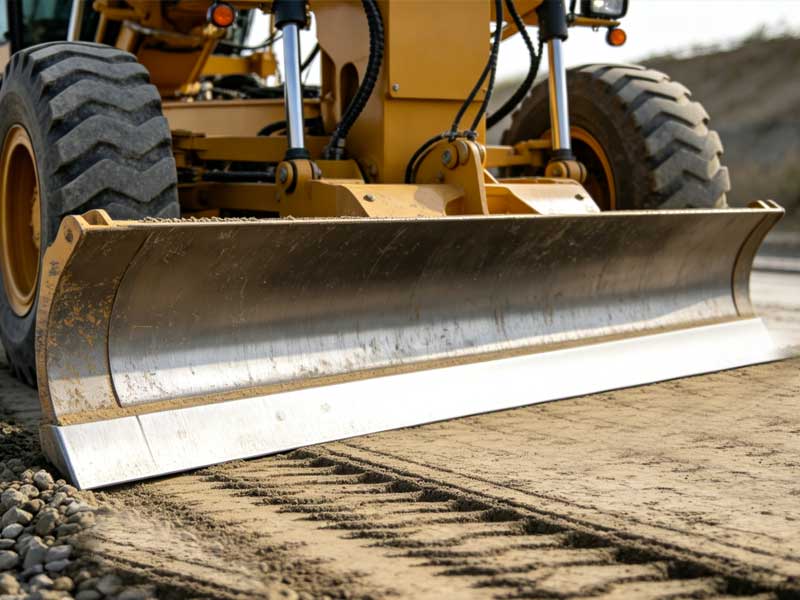
The core engineering trade‑off for grader GET lies in balancing hardness (abrasion resistance) and toughness (impact resistance). Over‑hardened material risks brittle fracture against rock; overly‑tough steel suffers fast abrasive wear in sand‑gravel environments.
Two mainstream material families dominate global grader wear‑parts market: high‑carbon steel and quenched‑and‑tempered boron steel.
Table 2: Material & Heat‑Treatment Specification Benchmark
| Material Grade | Alloy Composition | Heat‑Treatment Process | Brinell Hardness (HB) | Typical Service‑Life Multiplier | Application Profile |
|---|---|---|---|---|---|
| High‑Carbon Steel (1084 / 1090) | High carbon, low alloy | Single quench hardening | 250‑320 HB | 1.0× (baseline) | Loose soil, sand‑gravel, low‑impact grading jobs; cost‑sensitive light‑duty fleets |
| Boron Steel (30MnB series) | Manganese + trace boron element | Full quenching + tempering (through‑hardened) | 400‑530 HB | 2.0‑3.0× vs high‑carbon steel | Rocky terrain, frozen ground, heavy‑abrasion & high‑impact construction / mining sites |
Low‑cost high‑carbon steel products often achieve only surface hardening. Once surface‑hardened layer wears through, wear rate accelerates sharply.
Premium boron‑steel grader cutting edges achieve full through‑hardening. Hardness remains consistent from outer surface to core matrix, delivering stable wear rate throughout component service cycle.
3. Special Design Requirements for Grader End‑Bits
End‑bits sit at two ends of grader moldboard, bearing peak impact and abrasive loads. Procurement engineers should apply upgraded specification standards for end‑bits compared with central cutting edges:
- 1. Increased thickness: end‑bit thickness 15 %‑25 % thicker than standard middle cutting‑edge profile under equal length dimension.
- 2. Tungsten carbide overlay option: For extreme‑wear mining scenarios, tungsten‑carbide grid overlay is welded onto boron‑steel substrate. Tungsten carbide overlay can double end‑bit usable life, yet requires high‑yield‑strength base material to resist substrate deformation.
Table 3: Working‑Condition‑Driven GET Material Selection Reference
| Working Scenario | Primary Wear Mode | Recommended Material & Process |
|---|---|---|
| Soft soil, sand, minor gravel, road maintenance | Mild abrasion, low impact | 1084 / 1090 high‑carbon steel, quenched |
| Mixed gravel, scattered rock fragments, farm land leveling | Medium abrasion & occasional impact | 30MnB boron steel, quenched‑tempered through‑hardened |
| Mining sites, blasted rock, frozen ground, heavy rock contact | Severe abrasion + heavy shock loads | 30MnB boron‑steel base + tungsten carbide overlay for end‑bits |
4. Procurement Takeaways
1. Match material solution to real‑site working conditions instead of selecting purely based on unit price. Boron‑steel GET reduces change‑out frequency and machine downtime, delivering lower total operating expense for heavy‑duty fleets.
2. Verify through‑hardening performance rather than only surface‑hardness value when auditing supplier quality documentation. Request NDT and hardness‑gradient test reports for critical batches.
3. Combine correct part selection with strict maintenance schedules. Even premium boron‑steel grader blades will fail early if fastener retorque or moldboard protection rules are ignored.
TrueCast Engineering supplies OEM‑equivalent and custom motor grader GET parts: bolt‑on reversible cutting edges, grader end‑bits manufactured from qualified boron steel and high‑carbon steel, with optional tungsten carbide overlay service for heavy‑duty projects. Contact our engineering team for project‑specific material recommendation.